Bastiat’s “The Law” Is a Symphony of Ideas That Can Teach Us Justice

Frederic Bastiat’s “The Law,” written near the end of his life in 1850 France, is a symphony of ideas.

My high school economic students are reading their first book of the year, one that is close to the hearts of liberty lovers: Frederic Bastiat’s The Law, written near the end of his life in 1850 France. This is my third year teaching it to freshmen, and I find it more and more excellent every time I read it. The words and arguments come off the pages like notes and melodies, and it feels like a symphony of ideas.

Natural Law
Its first movement is powerful and audacious, beginning with a blasting fanfare of our natural, God-given rights. From nature we are granted life—physical, intellectual, and moral. Life alone cannot sustain itself, so we must apply the talents and faculties given to us by nature to develop, preserve, and perfect our lives. Continue reading →

Schools Are Tracking YOUR Child’s Mental Health – Whether YOU Like It or Not

Whether it’s security cameras, armed guards, or psychological screenings, mass schooling is becoming increasingly prison-like.

A worrying trend is emerging in schools across the country. With increasing regularity, school districts are tracking students’ mental health and raising flags if a screening shows something amiss. Continue reading →

Juntti: ‘Adulting Day’ At One High School Teaches Teens to Cook, Change a Tire and Pay Billscook, change a tire and pay bills

When I was in high school we had Home Ec and Shop to teach us those daily things. Home Ec also taught us how to care for an ill family member – how to change sheets and make a bed; how to sew things as well as how to keep a house clean and orderly. The shop classes taught woodworking, auto mechanics, etc.

The ADULTING DAY idea is great but it needs to be more of an ADULTING MONTH – including how to change a light bulb, how to fix a leaky faucet, how to clean a plugged drain, etc. All those things that are part of every day life. But then, nowadays, the schools would have to bring in professionals to show them how to do it as most teachers wouldn’t have a clue. I can just see todays youngsters (and adults) asking Google, Alexis, or those other talking tech things to tell them how to do something —other than to spy on all that goes on in your house.

How about teaching our kids how to do something PRODUCTIVE for a change???? ~ Jackie Juntti (Granny) Continue reading →

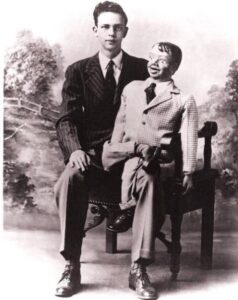
It’s Jesse ~ but NOT James…

His mother was 40 years old when Jesse was born. Jesse grew up in a very rough home in Morgantown, West Virginia. Jesse’s father, who was mentally ill, was a violent man and was abusive to Jesse. At 13, his father died leaving his mother to take care of him and his brothers. At the time, things weren’t easy for Jesse and he didn’t think life held much hope for him.

While Jesse had his struggles, he had dreams too. He wanted to be a ventriloquist and he found books on ventriloquism. He practiced with sock puppets and saved his money until he could get a real ventriloquist dummy. When he was old enough, he joined the military. Continue reading →

John Quincy Adams, Plymouth, Massachusetts, December 22, 1802

“Think of your forefathers and of your posterity.”

~ Prologue ~
Plymouth, Massachusetts, December 22, 1802 – “Man lives his highest destiny in the continuity of his interests as a unit within his family, his community and his country,” said Senator-elect John Quincy Adams in an oration marking the anniversary of the landing of the Pilgrims here almost two centuries ago.

It seemed as though Mr. Adams, from his vantage point of political privilege as son of the incumbent President, was voicing alarm at a general tone of self-seeking among our States and ourselves as individuals. He indicated strongly that perhaps we are falling into the pit of older societies, of using our great heritage for individual gain. Instead, he constrained his hearers to make their present activities a mark of devotion to the past and a foundation for the future of the whole of America. Continue reading →

Why Are So Many ‘Whiz Kids’ Homeschoolers?

It seems like every graduation season has its stories of whiz kids. The kids who are so ambitious and so accomplished that they’re graduating from high school, and even college, before the normal time.

One of the latest is 14-year-old Matthew McKenzie from Georgia, who received his high school diploma and associate degree the same day. And like many other whiz kids, McKenzie was – you guessed it – homeschooled. Matthew’s mother, Monique McCord tells the story:

“We would pull material from different textbooks and different resources so I would pretty much custom create his curriculum.” Continue reading →

President Thomas Jefferson: First Inaugural Address (March 4, 1801)

WASHINGTON, D. C., March 4, 1801 – Thomas Jefferson took the oath of office as President of the United States in an atmosphere which prompted him to devote all of his eloquence to restoring unity among the country’s leaders lest they fall into the divisions of parties against which President Washington warned.

The words of his Inaugural Address were hopeful expressions of unity. The facts were greatly different, for John Adams today sulked in anger against the open revolt led by Mr. Jefferson himself which started the movement called popularly the Republicans, that won the majority of the electoral vote for Mr. Jefferson and lobbed Mr. Adams of a second term.

In fact, until the very hour of the clock arrived last night that ended the administration of President Adams, he occupied himself in filling vacancies in public offices with hard-shell Federalists who might be expected to thwart the more radical tendencies of the new men following Mr. Jefferson under the Republican banner.

Chief among these appointees is Mr. John Marshall, who within the past twenty-four hours was named Chief Justice of the Supreme Court-a conservative Virginian counted upon to check, at the bench of ultimate appeal for all laws, such radicalism as may be written by the new Administration into the country’s laws.
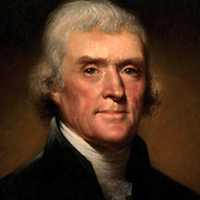
          President Thomas Jefferson

During the contest of opinion through which we have passed, the animation of discussions and of exertions has sometimes worn an aspect which might impose on strangers unused to think freely, and to speak and to write what they think; but this being now decided by the voice of the nation, announced according to the rules of the Constitution, all will of course arrange themselves under the will of the law, and unite in common efforts for the common good. All too will bear in mind this sacred principle, that though the will of the majority is in all cases to prevail, that will, to be rightful, must be reasonable; that the minority possess their equal rights, which equal laws must protect, and to violate which would be oppression.

Let us then, fellow-citizens, unite with one heart and one mind, let us re- store to social intercourse that harmony and affection without which liberty and even life itself are but dreary things. And let us reflect, that having banished from our land that religious intolerance under which mankind so long bled and suffered, we have yet gained little, if we countenance a political intolerance, as despotic, as wicked, and as capable of as bitter and bloody persecutions. During the throes and convulsions of the ancient world, during the agonizing spasms of infuriated man, seeking through blood and slaughter his long-lost liberty, it was not wonderful that the agitation of the billows should reach even this distant and peaceful shore; that this should be more felt and feared by some, and less by others, and should divide opinions as to measures of safety; but every difference of opinion is not a difference of principle. We have called by different names, brethren of the same principle. We are all Republicans; we are all Federalists. If there be any among us who wish to dissolve this Union, or to change its republican form, let them stand undisturbed as monuments of the safety I with which error of opinion may be tolerated, where reason is left free to combat it. I know, indeed, that some honest men fear that a republican government cannot be strong; that this government is not strong enough. But would the honest patriot, in the full tide of successful experiment, abandon a government which has so far kept us free and firm, on the theoretic and visionary fear, that this government, the world’s best hope, may, by possibility, want energy to preserve itself? I trust not. I believe this, on the contrary, the strongest government on earth. I believe it the only one where every man, at the call of the law, would fly to the standard of the law, and would meet invasions of the public order as his own personal concern. Sometimes it is said that man cannot be trusted with the government of himself. Can he then be trusted with the government of others? Or, have we found angels in the form of kings, to govern him? Let history answer this question.

Let us then, with courage and confidence, pursue our own federal and republican principles; our attachment to union and representative government. Kindly separated by nature and a wide ocean from the exterminating havoc of one quarter of the globe; too high-minded to endure the degradation of the others, possessing a chosen country, with room enough for our descendants to the thousandth and thousandth generation, entertaining a due sense of our equal right to the use of our own faculties, to the acquisition of our own industry, to honor and confidence from our fellow-citizens, resulting not from birth, but from our actions and their sense of them, enlightened by a benign religion, professed in deed and practised in various forms, yet all of them inculcating honesty, truth, temperance, gratitude, and the love of man, acknowledging and adoring an overruling Providence, which, by all its dispensations, proves that it delights in the happiness of man here, and his greater happiness hereafter; with all these blessings, what more is necessary to make us a happy and prosperous people? Still one thing more, fellow-citizens, a wise and frugal government, which shall restrain men from injuring one another, shall leave them otherwise free to regulate their own pursuits of industry and improvement, and shall not take from the mouth of labor the bread it has earned. This is the sum of good government; and this is necessary to close the circle of our felicities.

Postlogue:
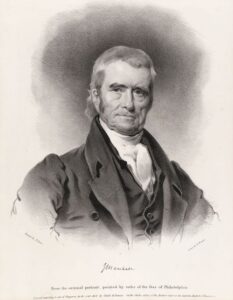
                  Chief Justice John Marshall

This Inaugural Address by President Jefferson did not close the gap in political ranks. In fact, his election I marked the birth of the two-party system which, while he could not know it and despite Washington’s warnings, against such a decision, has become one of the great strengths of the American form of politics. For more than a century and a half, American politics have been planted upon the basic idea of responsible leadership by a majority party and the exercise of checks and balances by a responsible minority party; never a pluralty of parties that make possible grasp of leadership by a minority spokesman on the basis of deals with a host of minor parties. Such a system wrecked the French Fourth Republic.

As an echo of the Adams – Jefferson division, the United States won the service of John Marshall as Chief Justice for 35 years, in which time he made the reputation of probably the greatest man to hold that office.

His appointment as a result of John Adams temporary spite became perhaps the most notable action by that stern old New Englander.
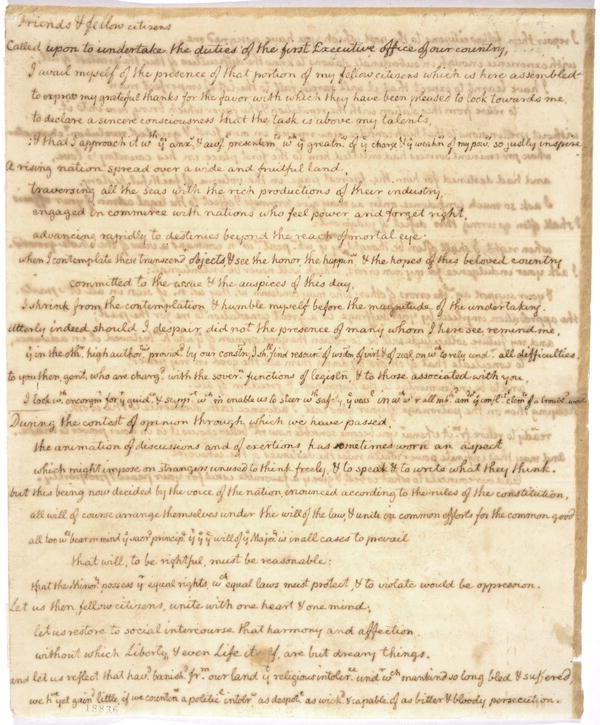
            Inaugural Address, [March 4, 1801], reading copy, in Jefferson’s hand. | Library of Congress

It’s every young person’s dream come true: ‘no more grades in school!’

Since some children find letter grades “offensive,” public school teachers are now grading with “colors, numbers and symbols”

Because some students are apparently getting “offended” or having their feelings hurt by receiving B’s on their tests instead of A’s, public schools in Wisconsin are reportedly abandoning the traditional grading system in favor of assigning students “colors” and “symbols” instead.

This newfangled “target-based grading system,” as they’re calling it, means that the days of using actual metrics to determine student scholarship are over. Now, random images and pretty colors will govern public education. Continue reading →

Benson: Public Schools Are A Dismal Failure

Today, I read an excellent article by Justin Spears via the Foundation for Economic Education. I would urge concerned parents to check it out.

Mr. Spears starts out with: “In the first part of this article set, my colleague Mike Margeson spelled out the historical roots of the American schooling system. He clearly laid out the blueprint that men like Horace Mann used to build a system that does anything but ‘educates’.” What he is saying here is that Unitarian Horace Mann provided this country with an “educational system” that was, essentially worthless! Seeing that Mann’s main intent was not to educate but to downplay the influence of Christian schools in this country, I am not surprised. Mann has a reputation as an inventive educator that is not deserved. Continue reading →

Home Is Where the Classroom Is…

Eighty percent of the Anaheim school district may be Spanish-speaking, but parents know how to say one thing, “Enough!” When classrooms started passing off transgender propaganda as part the “wellness” curriculum, one mom made sure every Latino family knew exactly what the district was up to. Pretty soon, the message from moms and dads needed no translation: drop your campaign — or spend the next year fighting the community. Continue reading →

End School Compulsory-Attendance Laws

Imagine if Congress were to enact a law that required everyone to attend church on Sundays. The overwhelming majority of Americans would go up in arms. The concept of religious liberty is so deeply ingrained in our American heritage that there is no way that people, including devout Christians, would accept such a law. That heritage was enshrined in the First Amendment, which prohibits Congress from enacting such a law.

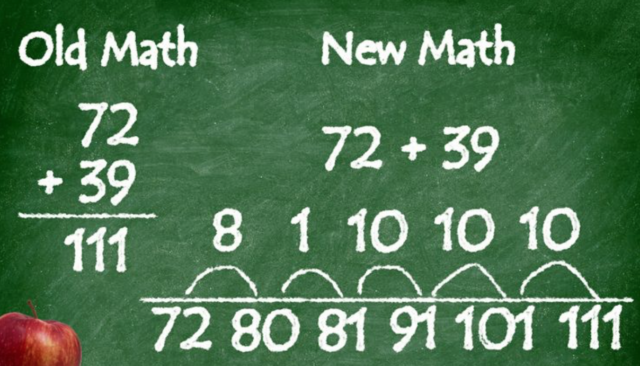
Now, suppose things had been the exact opposite… Continue reading →

The History and Results of America’s Disastrous Public School System

The earliest ancestor to our system of government-mandated schooling comes from 16th-century Germany.

Image Credit: NPS Photo by John Tobiason

~ Part I ~

While it’s almost universally understood that the American school system is underperforming, “reform,” too, is almost universally prescribed as the solution. Yet in other walks of life, bad ideas are not reformed—they are eliminated and replaced with better ones. Our school system is rarely identified as a bad idea.

The system is reflexively left alone while the methods are the bad ideas that get cycled in and out: open concept schools, multiple intelligences, project-based learning, universal design for learning, merit-based pay, vouchers, charters, and most recently, educational neuroscience. Every decade or so we are told by the pedagogic experts that they have found an answer to our school’s problems. The trouble is, they’re looking right past the problem.
Continue reading →

Restructuring American Education

What will it take to reshape our care-worn system? Money, talent, and time.

Editor’s NOTE: There are times when Metropolis Café finds it beneficial to take a time machine back some years – just to study how our Public Education system was being looked upon at that time. The following was written in early 2002. How far we have fallen – and the same questions are being asked 17 years later. ~ Ed.

More teachers, more vouchers, more computers, more charter schools, more tests, more federal money, more local control, more, more, more. The calls constitute a cacophony of pleas and threats, warnings and promises from public figures, parents, teachers, and other citizens – all asking for more learning.
As each call is debated, pushed, shot down, revived, and discarded again, we move around the same endless circle, once again looking for a place to stick another Band-Aid on an institution suffering from malnutrition and structural inadequacy. Continue reading →

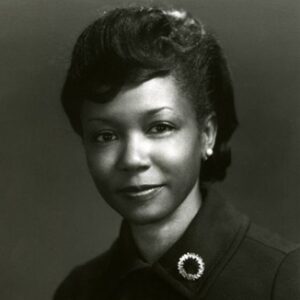
Dr. Mildred F. Jefferson

March is recognized by the U.S. Government as “Women’s History Month.” According to womenshistorymonth.gov, we “join in paying tribute to the generations of women whose commitment to nature and the planet have proved invaluable to society”. There are countless women who have dedicated themselves to making the world a better place and to ushering in a turning point in history, so it’s fitting that we should honor and celebrate them this month.
Surgeon, right-to-life activist, and noted speaker, Mildred Fay Jefferson was the first African American woman to graduate from Harvard Medical School in 1951. Continue reading →

When Congress Officially Declared that the Civil War was Not About Slavery

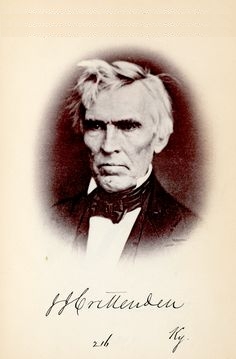
John Crittenden

It was July of 1861, and things were looking bad for the United States. The December before, South Carolina had seceded, and the gulf states followed in quick succession throughout January, with Texas joining on February 1. Then, as it became unmistakable that the United States intended to invade the seceded states, and force all other states to take up arms against them, the mid-Southern states had no choice but to secede as well, starting with Virginia’s departure from the Union in April, and concluding with Tennessee’s secession on June 8.

Already the situation was dire, but it was by no means clear that other states would remain. Maryland, Kentucky and Missouri were all popularly inclined to join the seceded states, and Maryland’s secession in particular would have been disastrous, causing Washington to be surrounded by states of the Confederacy. Continue reading →

The U.S. is a Democratic Constitutional Republic, and Yes, It Matters

James Madison, the father of the U.S. Constitution and primary author of the Bill of Rights, repeatedly emphasized that the United States is a “republic” and not a “democracy.” In stark contrast, Jonathan Bernstein, a Bloomberg columnist and former political science professor recently insisted:

“One of this age’s great crank ideas, that the U.S. is a ‘republic’ and not a ‘democracy’, is gaining so much ground that people in Michigan are trying to rewrite textbooks to get rid of the term ‘democracy’.”

“For all practical purposes, and in most contexts, ‘republic’ and ‘democracy’ are synonyms.” Continue reading →

Why Schools Must Stop Relying on ‘Best Practices’ When Teaching Writing

When it comes to writing, American kids just don’t cut it. Only 27 percent of eighth grade students achieve proficiency in the subject, according to The Nation’s Report Card.
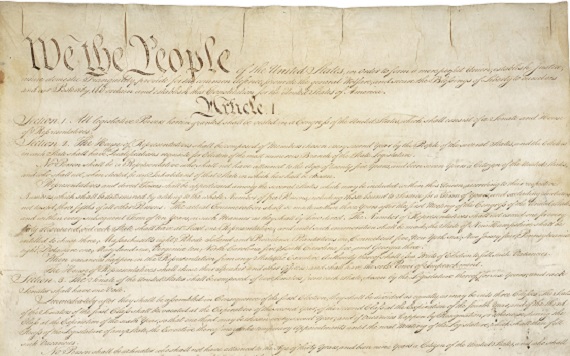
That shouldn’t surprise us given the type of writing instruction which takes place in schools. Today’s writing instruction, a recent op-ed from The Hechinger Report explains, revolves around a child expressing his ideas on paper. Schools seem to believe that students have all the knowledge and inspiration locked up inside them. This knowledge simply needs to be let loose in order to create a written masterpiece. Continue reading →

The Defining Differences Between the United States and Confederate Constitutions

In 1861 the CSA returned sovereignty to where nature and Nature’s God place it: within the individual person and the polity he and she have decided to belong to. ~ V.M.

“Their revolution (the South in 1861) … was in fact an act of restoration, for the constitution drawn up in Montgomery in 1861 for the Confederate States of America was a virtual duplicate of the United States Constitution.” John McCardell in his Introduction to Jesse T. Carpenter’s “The South as a Conscious Minority, 1789 – 1861”, re-published by the University of South Carolina Press, 1990, p. xiv-xv (emphasis added)

This is a common misperception. The CSA Constitution is not “a virtual duplicate” of the 1787 Constitution. It is a document of greater clarity and stricter understanding. There’s no fabulating. Here’s a list of four (4) major changes: Continue reading →

Mis-education: An inside job…

College board president behind SAT ‘adversity score’ was also the mastermind of the controversial K-12 ‘Common Core’ curriculum changes that has children just learning for a test

College Board president David Coleman

The man behind the new plan to assign adversity scores to every student who takes the SAT is the same person who championed the controversial Common Core K-12 curriculum standards that remain a point of contention among parents, teachers and political leaders in many states.

David Coleman, president of The College Board, which administers the SAT, was the ‘architect of Common Core’ – which several states dropped after its adoption due to pressure from local communities and educators, according to Fox News.

Proponents of Common Core say the method was meant to establish a baseline of curriculum standards for K-12 education, with a focus on math and English language arts literacy.

It implemented broad new standards for how much a student should know and be able to do at the end of each scholastic year, leading to what critics said was ‘teaching to the test’ – or a system in which teachers are under so much pressure to get their students to perform well on the test that other educational priorities fell by the wayside in favor of test preparation. Continue reading →