Category Archives: Profiles

Biographical commentary on famous people – of note – and maybe not so.

WARNINGS from Dwight D. Eisenhower

Over the past sixty years, there has been a significant shift, in how historians perceive President Dwight D. Eisenhower. In a survey conducted in 1962, Eisenhower was ranked 22nd among Presidents, considered just an average leader, comparable to Chester A. Arthur, and slightly superior to Andrew Johnson. However, by the 1980s, his standing had risen to 11th place, and by 1994, he had climbed to 8th. This position has remained consistent, as evidenced by current polls of presidential historians. Among Presidents who served in the last 75 years, he was surpassed in ranking only by Franklin D. Roosevelt and Harry S. Truman. So, who was the real Dwight D. Eisenhower? Continue reading
DeWeese: He Brought Us From Darkness

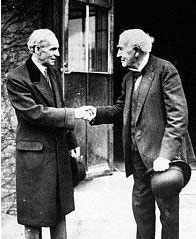
Thomas Edison and Henry Ford

Into the chilled October night four figures cut through the dark. Over the railroad tracks, down the dirt streets, past the preserved homes and the silent shops, they quietly made their way to a group of buildings just ahead.

The short elderly man in the middle seemed to be the center of their concern. As the group ascended the stairs inside the long wooden building one man held his arm in assistance. At the top of the stairs another helped him out of his coat. The third led him to a seat at the end of a long work bench.

In front of his chair there had been erected a plank of wood about six feet high and six inches across. On it were tubes and wires running from the top to the floor. A glass globe lay on the workbench.

The old man paused for a moment, brushed the lock of white hair from his eyes and began to work. One of the men assisted as the other two watched with smiles and intensity for the work being completed. Continue reading

Benjamin Franklin: ‘Money has never made man happy. The more one has, the more one wants

Benjamin Franklin, a Founding Father, believed money could not bring lasting happiness. His life showed that desire grows with wealth, not contentment. Franklin, from modest beginnings, achieved great influence through self-education and public service. He established institutions and made scientific discoveries. His focus was on purpose, learning, and self-control, not accumulation. This perspective remains relevant today. Continue reading

The Hollywood Starlet We Have To Thank for Wi-Fi

When you think of Hollywood’s Golden Age, you probably conjure images of glamorous actresses walking the red carpet and lighting up the silver screen with their charm, looks, and talent. You most likely wouldn’t think that any of them were pioneering inventors who ushered in the age of global communication.
Hedy Lamarr was one of Hollywood’s brightest stars. Many consider her to be a film icon, and she was called the most beautiful woman in the world. But behind her appearance, acting talent, and international fame was the mind of a brilliant inventor whose efforts laid the foundation for Wi-Fi, Bluetooth, and modern wireless networks.

While her contributions weren’t recognized in her lifetime, she is now celebrated for her brilliance and stands as evidence that genius doesn’t have to look a certain way. Continue reading

Theodore Roosevelt Cracks Down on NYC Corruption

It took a 100 years for them to destroy his monopoly laws. That’s why we only have 2 or 3 technological companies controlling the internet right now. Because our government destroys the monopoly laws so that they could do that. They’ve been given special permission to do it just like the sports teams have been given special permission to ignore the monopoly laws. ~ Tony Moore

In a Word: National Dictionary Day

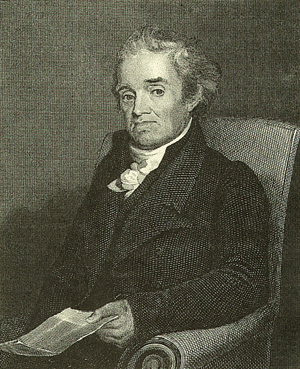
Why dictionary lovers celebrate Noah Webster’s birthday.

Noah Webster

On October 16, 1758, Noah Webster and his wife Mercy Steel Webster welcomed a new son into their lives. They named him after his father. Noah Sr. was a farmer and weaver, and Mercy was a homemaker, and by all outward appearances, they lived a rather normal life in the West Division of Hartford — what would become West Hartford, Connecticut.

Though the elder Webster had never attended college himself, he placed great value on education, so from an early age, Mercy taught the younger Noah what she could of spelling, mathematics, music, and other subjects. At age 6, he began attending a one-room schoolhouse; later in life, he described his untrained teachers there as the “dregs of humanity.” Continue reading

Documentary: Tuskegee Airmen

Back in the 1980’s, a firm that I was part owner of had the privilege of performing and intense home security project for a man who had been one of the Tuskegee Airmen and who was having a new home built in Flagstaff, Arizona. His name was Lincoln Ragsdale – and I will soon have the privilege of publishing his life’s story in the Profiles pages of Metropolis.Café.

THIS is part of America’s History! ~ Jeffrey Bennett, Editor

Whispers in the Wind: Jane Goodall’s Final Words and Lasting Legacy

Over my own lifetime, I have had a huge appreciation for this world we’ve been handed to steward and do with as we wish. And it’s always been my wish that we as humans across the globe always wish and choose wisely, if only that all life survives and thrives.

This isn’t a communist or capitalist – left-right – issue, since the health of the Earth and our environment has a marked, significant effect on all life on the planet, and it’s just pure old, good and simple common-sense that we should all do our utmost best to keep the environment as pure and clean as possible for the sake of future generations and humanity overall.

But curiously, if one does their due diligence, one will find that historically, it is the developed, capitalist nations of the globe that have the best track record for protecting wildlife and the environment.

The following is a tribute to one of the most amazing women I have never had the opportunity to meet, a lady I would have given my eye-teeth to have met in my early manhood days. She is the sort of lady who provides inspiration to all to be better than the person you were yesterday, to do better for those you may leave behind upon your own death. ~ J.O.S.  Continue reading

How a Communist Turned Conservative Reshaped America

William F. Buckley called him “Mission Control.” National Review publisher Bill Rusher referred to him as “the Master.”
From Australia, Professor Hiram Caton described him as “the central nervous system of the body conservative, the only man who was in constant touch with what all of us in the remote regions were thinking.”

When Frank S. Meyer died more than a half-century ago, America’s right-wing remembered him as an organizer extraordinaire involved in the founding of such groups as the American Conservative Union and the Philadelphia Society, a mentor to such talents as Joan Didion, Garry Wills, and Guy Davenport as National Review’s literary editor, and the originator of fusionism, which wedded tradition with liberty and served as the de facto philosophy of American conservatives from Barry Goldwater well through Ronald Reagan. Continue reading

Charles Dickens’s Daily Routine: Cold Plunges, Long Walks, and Set Hours

Instead of waiting for inspiration to strike, Charles Dickens used discipline, exercise, and structure to produce genius.

“Dickens’s Dream” by Robert William Buss, 1875.

The much-beloved writer Charles Dickens has been widely hailed as the greatest Victorian novelist. He was the Victorian equivalent of a rock star, going on tour around England and internationally, enjoying greater popularity during his earthly years than any prior writer had.

But like many other great artists, Dickens did not stumble into his fame and success by accident. It was the result of conscious effort, discipline, and a well-balanced daily routine – combined, of course, with once-in-a-generation genius and native talent. The results were awe-inspiring and continue to captivate readers in all the 150 languages into which his work has been translated. Continue reading

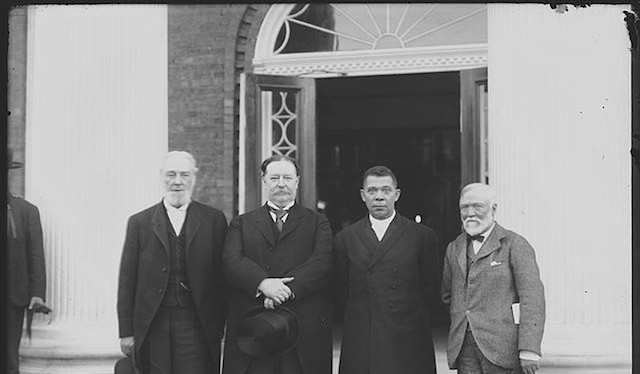
Booker T. Washington’s Wise Advice on Education and Personal Responsibility

Frances Benjamin Johnston/Library of Congress via AP

Booker T. Washington was one of the greatest American educators, and we could not do better in our quest to reform our educational system than to adopt his plan of combining trades with classical learning, thus training the hands, the head, and the heart.

Washington, who had been born a slave on April 5, 1856, and even after freedom always had to work incredibly hard for the learning he obtained, understood the vital importance of education. But he did not want it to be mere literacy or checked-off boxes, as is so often the case in Communist nations, and now even in the United States. A bad education, particularly one with bad morals and principles, can be just as harmful as no education at all, or even more harmful. Continue reading

Jimmy Carter: A Man of Vision, Faith and Humility

In his announcement speech for his presidential run , in 1974, Georgia Governor Jimmy Carter said there were things he would not do to become President: “I would not tell a lie. I would not mislead the American people … and I would not betray your trust.”

If anything defined President Carter, it was his basic decency and morality. Continue reading

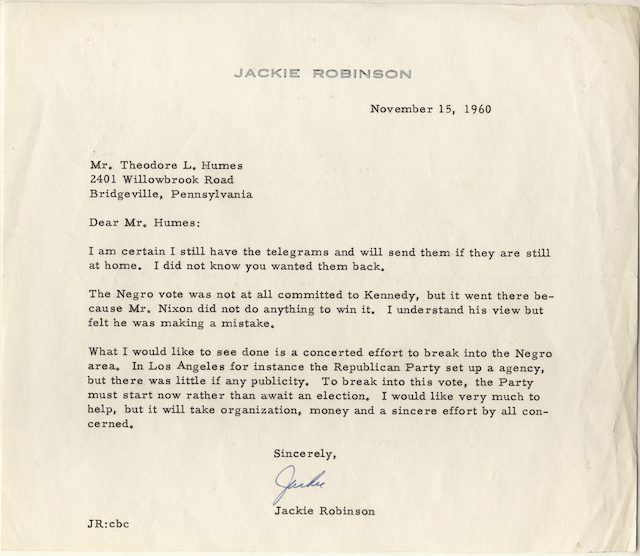
Jackie Robinson Reflects on the Importance of “the Negro Vote” in Nixon’s Loss to Kennedy

“The negro vote was not at all committed to Kennedy, but it went there because Mr. Nixon did not do anything to win it. I understand his view but felt he was making a mistake …”

The famous retired baseball star – at that time an NAACP fundraiser and vice president of Chock Full O’ Nuts coffee – campaigned hard for Richard Nixon in 1960. Here, in the aftermath of defeat, he offers suggestions as to how the party of Lincoln might attract more future African-American voters in his (and Nixon’s) native California.

     JACKIE ROBINSON. Typed Letter Signed, “Jackie”, to Theodore L. Humes. [n.p.], November 15, 1960. 1 p., on personal letterhead.

Continue reading

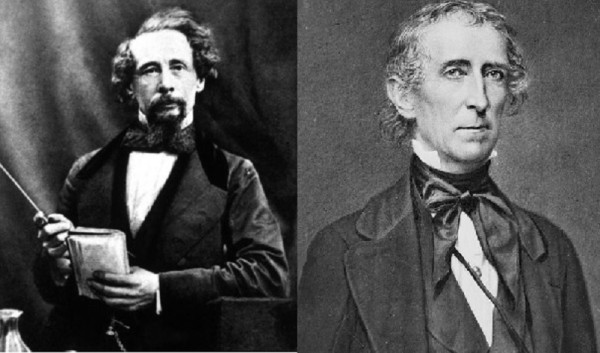
When Charles Dickens visited the White House, No One Answered So He Let Himself In.

Charles Dickens and President John Tyler

As part of an extensive tour of the United States that encompassed most of the first half of 1842, English author Charles Dickens earned an invitation to meet President John Tyler at the White House. However, this visit left a lot to be desired on the part of the author, beginning with his attempt to actually locate the commander in chief.

As explained in his travelogue American Notes, Dickens and an unnamed official, “having twice or thrice rung a bell which nobody answered,” simply entered the White House and attempted to find the president on their own. Continue reading

When Kennedy Became a Hero in 1943

                                                                  Lt. John_F. Kennedy aboard the PT-109

In the early hours of August 2, 1943, a Japanese destroyer rammed an American PT (patrol torpedo) boat, No. 109, slicing it in two. The destruction is so massive other American PT boats in the area assume the crew is dead.

Two crewmen were, in fact, killed, but 11 survived, including Lt. John F. Kennedy. Continue reading

Jesse Owens’ Four Gold Medals at the 1936 Olympics in Berlin Were a ‘Thumb in the Eye‘ to Adolf Hitler

      Jesse Owens won four gold medals at the 1936 Olympics, set in the backdrop of Nazi Germany

Jesse Owens’ grandson said his track-legend grandfather’s successes at the 1936 Olympics in Berlin were a ‘thumb in the eye‘ to Adolf Hitler.

To commemorate the 4th of July, and the beginning of the Paris Olympics in 2024, Owens’ name was back in the news as one of the greatest American Olympians of all-time. Continue reading

Surviving Tuskegee Airman Turns 100 on Independence Day

One of the few surviving Tuskegee Airmen – and one of the four original Top Guns – turned 100 on Independence Day surrounded by friends, family, and television cameras for the big event.

Retired Air Force Lt. Col. Harry T. Stewart Jr. celebrated his centennial milestone on Thursday with a party that the Detroit chapter of the Tuskegee Airmen and the Tuskegee National Historical Museum hosted. Continue reading

WWII Veteran Is Also The Only Living Son Of A Civil War Soldier

William Pool fought at the Battle of the Bulge in 1944. His father fought for the Union Army in the 1860s.

Serving in the military is a family tradition for William Pool.

The 99-year-old veteran fought at the Battle of the Bulge in 1944, while his father fought for the Union Army during the Civil War in the 1860s.

Yes, that’s not a typo. Pool is the only living son of a Civil War soldier, according to KYTV, an NBC affiliate in Springfield, Missouri.

In honor of Flag Day, KYTV did a deep dive on Pool’s unusual family heritage, speaking with Pool, his daughters, Carolyn George and Jeanie Price, and author Tim Pletkovich about it.

Citing Pletkovich’s book, “Civil War Fathers: Sons of the Civil War in WWII,” which includes a chapter on the Pool family, KYTV explained how Pool’s father, Charles Pool, fought for the Union with the Sixth West Virginia Volunteers during the Civil War and received a pension for his service. Continue reading

Sacagawea — The Woman Who Shaped American History

Back in the early 19th century, when the United States started its westward expansion, one remarkable woman emerged as an essential figure in American history: Sacagawea. Born around 1788 in what is now Idaho, Sacagawea was a Shoshone woman whose knowledge, skills, and resilience were instrumental in the success of the Lewis and Clark Expedition. Even though many of us have heard of her, not too many people know how important her role truly was. So, let’s learn a bit more about this extraordinarily brave and intelligent woman who helped shape the course of American history. Continue reading