They Thought They Were Free

History repeats because human nature remains the same…

But Then It Was Too Late
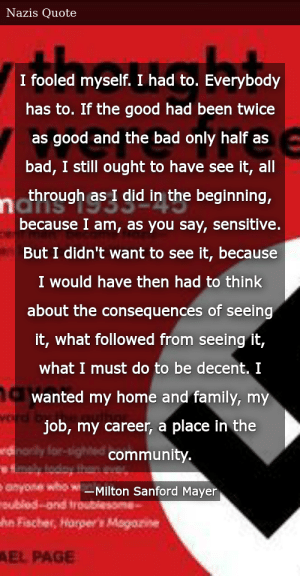
What no one seemed to notice,” said a colleague of mine, a philologist, “was the ever widening gap, after 1933, between the government and the people. Just think how very wide this gap was to begin with, here in Germany. And it became always wider. You know, it doesn’t make people close to their government to be told that this is a people’s government, a true democracy, or to be enrolled in civilian defense, or even to vote. All this has little, really nothing, to do with knowing one is governing.

“What happened here was the gradual habituation of the people, little by little, to being governed by surprise; to receiving decisions deliberated in secret; to believing that the situation was so complicated that the government had to act on information which the people could not understand, or so dangerous that, even if the people could not understand it, it could not be released because of national security. And their sense of identification with Hitler, their trust in him, made it easier to widen this gap and reassured those who would otherwise have worried about it. Continue reading →
Activist, Brigitte Bardot

Last year, singling out screen legends such as Marilyn Monroe and Marlene Dietrich, who died alone, Bardot told Dalya Alberge: “The majority of great actresses met tragic ends. When I said goodbye to this job, to this life of opulence and glitter, images and adoration, the quest to be desired, I was saving my life.”
However, Bardot’s views and her strong opposition to Islam in France have led to her being condemned by French courts for anti-Muslim comments, and fined. She faced French judges five times for “incitement to racial hatred” between 1997 and 2008.

In 1996, she pointed to her grandfather and father’s battles against German invaders in two world wars, and to her own rejection of lucrative Hollywood offers during her “cinematic glory.” Ms Bardot wrote: “And now my country, France, my fatherland, my land, is, with the blessing of successive governments, again invaded by a foreign, especially Muslim, overpopulation to which we pay allegiance. Continue reading →

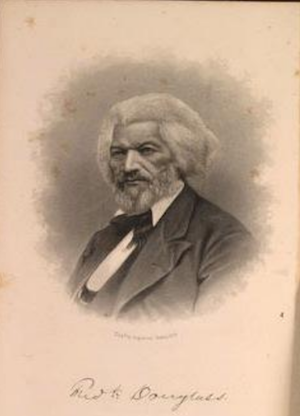
Descendants of Frederick Douglass Read From One of the Greatest Speeches in American History

Without leadership, the mob may win and the resulting chaos will benefit no one except those who foment it.

Americans used to have great reverence for the spoken word. Before radio and TV, there were political speeches and the great orators were prized for their ability to move audiences to laughter, to tears, or to rage.


It’s ironic that some of the most famous and beloved Americans were terrible public speakers. Jefferson stammered his way through his first inaugural. Washington hated to speak in public — partly because his teeth kept slipping.

Abraham Lincoln’s speaking voice was a high-pitched, nasally whine. But what he said moved mountains. The Gettysburg Address redefined freedom and liberty in a way that everyone understood and believed. His second inaugural address (the shortest in history) — “With malice toward none and charity for all” — became public policy the minute he uttered it. Continue reading →

Don’t Cheer Woodrow Wilson’s Cancellation

Rather than taking scalps of our own, what the right needs is an arms-linked defense of our history, culture, art, and institutions, imperfect though all that might be.

First things first: Woodrow Wilson was a deplorable bigot and one of the worst presidents in American history. He re-segregated the federal government, glamorized the Ku Klux Klan, screened The Birth of a Nation at the White House, and opposed Reconstruction and black suffrage (Dylan Matthews has more on Wilson’s racism). In common with many progressive intellectuals of his time, he was a champion of eugenics. He sank the United States into the pointless carnage of World War I. He viewed the Constitution as outmoded and sought to snap its restraints on executive power. Continue reading →

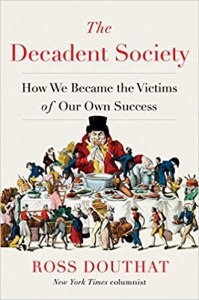
“The Decadent Society” & the Summer of Our Discontent

In “The Decadent Society,” Ross Douthat’s definition of decadence reaches more deeply into the underlying causes of our present rot. Is American society sick, sclerotic, sterile, and stagnant, as he suggests?

There is a chapter in Ross Douthat’s new book, The Decadent Society, called “Waiting for the Barbarians.” The book came out just before our present summer of discontent in which we’ve seen home-grown barbarians rampaging through our streets. Like the old-fashioned breed of barbarians, their ignorance blends mightily with their violence. The only difference being that they have added to their ignorance and violence a distasteful stench of self-righteousness.

Mr. Douthat analyzes the state of American society by first defining his terms. By “decadence” he does not simply mean moral depravity, the disgusting self-indulgence of a Caligula, or the insane violence of Nero or Idi Amin. He does not exclude these excesses, but his definition of decadence reaches more deeply into the underlying causes of our present rot. He does so with the symbolism of “four horsemen”: Stagnation, Sterility, Sclerosis, and Repetition. Continue reading →

The Herd of Sheep in American Schools

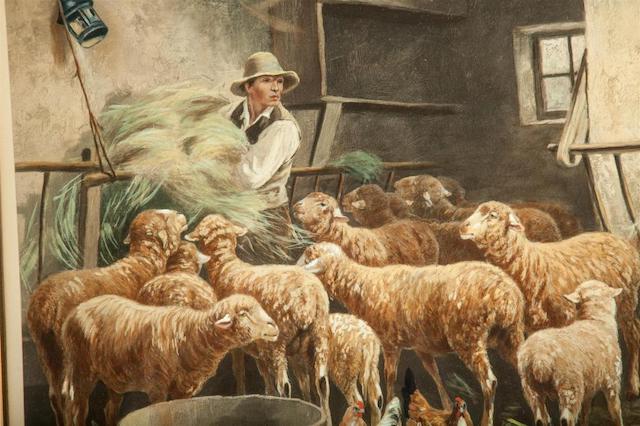
BARNYARD WITH SHEEP (AMERICAN SCHOOL, EARLY 20TH CENTURY)

By now you’ve probably heard of Harvard Professor Elizabeth Bartholet, whose name catapulted into the public’s view when she called for a “presumtive ban” on homeschooling. Ironically, her call for a homeschooling ban came right when the entire nation was forced to homeschool due to the COVID-19 outbreak. Continue reading →

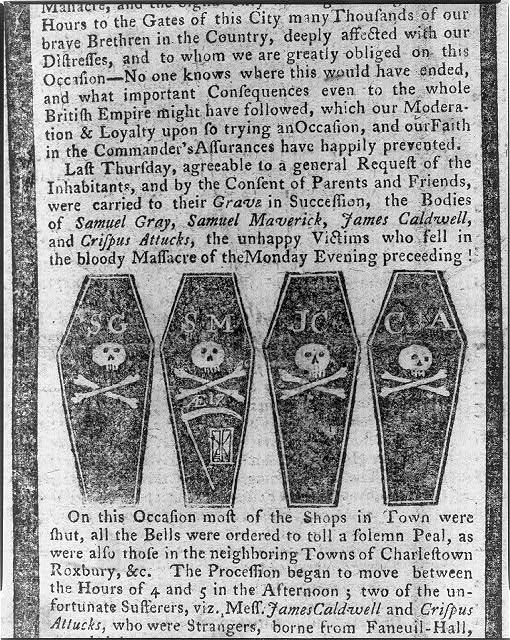
From the Boston Massacre to the Boston Tea Party: Massachusetts Kicks Off a Revolution

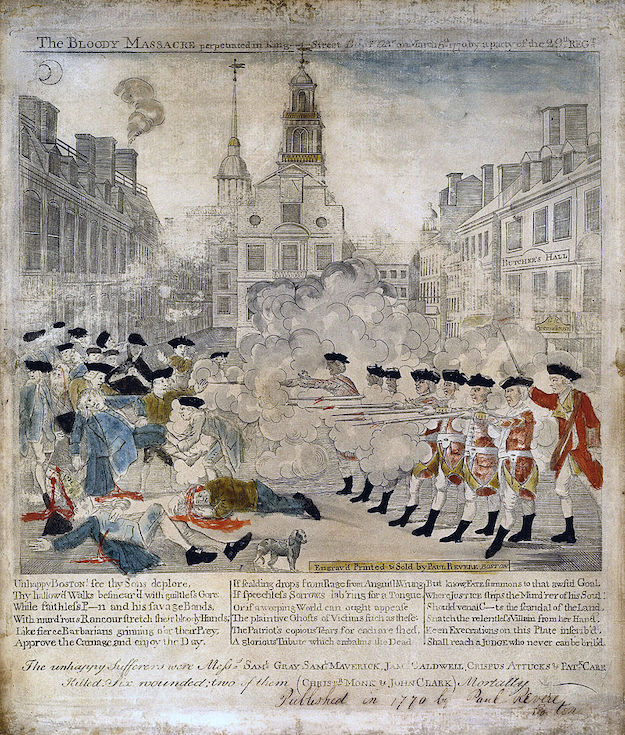
This famous depiction of the Boston Massacre was engraved by Paul Revere (copied from an engraving by Henry Pelham), colored by Christian Remick, and printed by Benjamin Edes. The Old State House is depicted in the background. / Library of Congress

Different Conceptions of Colonists’ Relationship to Britain

Article by Samuel Adams in the Boston Gazette about the Boston Massacre

Following the the Boston Massacre in 1770, there were different ways in which both onlookers in the British government and the colonists ended up wondering, each one, if the other one was somehow engaged in a plot. Right? And I mentioned that the British were perhaps wondering if this had all been a plot to rob the customs house; the colonists were wondering about the possibility of this being some kind of ongoing plot to subdue and repress the American colonists. So clearly at the end of the lecture from last week you can really begin to sense a growing sense of mounting hostility, even among some people a sense of growing alienation.

And you can hear this on both sides coming from the accounts of the Boston Massacre by both Gage and Adams. And I did mention in class when I read from them that they were of course writing with a purpose in mind so they were interested in being particularly bold and dramatic in what they were saying. Gage really had to excuse what happened and Adams was trying to promote people to get upset about what had happened, but even so you can hear even just in the way that they framed their accounts some of what I’m talking about here with growing hostility, growing alienation. Continue reading →

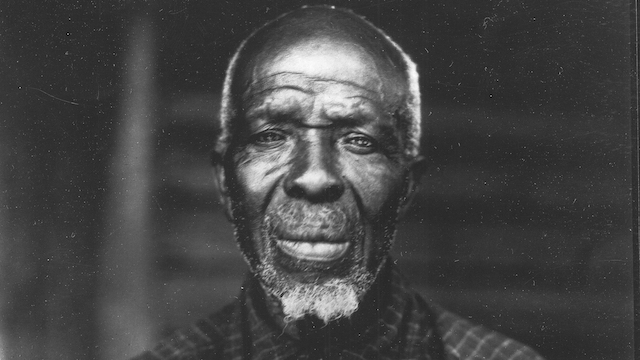
Charles Mason: A Voice of Reason

Charles Mason

Today, as it was a hundred and sixty years ago, America stands on the edge of an ever-widening chasm of cultural, ideological, political, racial and sectional divisions. In 1860, there was at least one prominent voice of reason that cried out to end the nation’s mad rush into the abyss, that of Charles Mason of Iowa. Mason was a Northern Democrat who not only understood the conflicting issues that were then pulling the nation apart, but reasonably viewed the rights and wrongs of both secession and slavery, as well as strongly opposing Lincoln’s invasion of the South to militarily force the departed States back into the Union. Like many others in both the North and South, Mason did not approve of secession, but felt that as there was nothing in the Constitution to bar a State from abrogating its contract with America and peacefully withdrawing from the Union, that it was solely a matter for the people of each State to decide on their own. His fervent hope though was that if secession did become a reality and a new Southern nation created, that the two countries could then begin to negotiate their differences in a peaceful manner, somehow resolve them and ultimately reunite. Continue reading →

How Public Schools Indoctrinate Kids Without Almost Anyone Noticing

Teaching the value of free thought matters now more than ever.

Unfortunately, most American public schools take the opposite approach.

Many people have long suspected that governments sometimes attempt to indoctrinate their people to increase the government’s own power and influence. Unfortunately, ambitious governments will not stop at merely controlling what their people can do; they must control their minds. Continue reading →

If you have a Child in Public School, you’re sending them into a Warzone!

Hate Crimes against White Students on the Rise (And this was in 2019)

A teacher for Hays CISD, south of Austin, Texas was arrested Friday afternoon after she beat the hell out of a 15-year-old girl in a classroom. Sadly, like most of these attacks, it will go unreported by the large corporate cable news networks because it doesn’t fit the agenda and it would be inconvenient to show what’s really going on in public schools throughout the United States.

The latest incident was caught on cell phone by students in the class, as CISD teacher Tiffani Shadell Lankford brutally attacked the girl.

Hate Crimes against White Students ignored & covered up by the Media and Public School Systems throughout the United States!

In schools throughout the United States, white students are being targeted in brutal hate crimes that go mostly unreported, and shockingly the terrorists thugs often go unpunished. In fact, schools throughout the United States have changed their disciplinary policies specifically to protect minority students from suspension and expulsion. Continue reading →

A Virtual Educational Failure

Lockdowns changed education for millions of students, and not always in a good way.

When states closed American schools due to the coronavirus pandemic, state boards of education reacted quickly to ensure that students would continue to learn. Online technologies such as Zoom, for example, were implemented so teachers and students could meet in real time. On the surface, it seemed like the perfect solution. We’ve all seen videos or news clips of a computer screen filled with the faces of eager students hanging on the teacher’s every word. Parents walking into the kitchen were likely reassured to see their child staring into the laptop while the teacher explained the lesson in the background. But the reality paints a much less successful picture of the virtual schoolhouse.

For one, a significant number of students never show up for class — which makes sense, given how much easier it is now to hit the snooze button and grab another couple hours of sleep. Just email your teacher later and explain that your Internet was down. Continue reading →

1864 ~ Gold Speculation

The Union’s financial success depended on military success. As presidential aide John Hay wrote in an anonymous newspaper article in January 1862 when any movement by the Union Army was stalled: “The Secretary of Finance has displayed wonderful zeal and ability in filling a bankrupt treasury and supplying the sinews of war. In this respect, Mr. Chase has accomplished a herculean task, but all his plans and efforts will end in ruin unless followed by wholesome legislative enactments and decided military movements. Already the treasury notes have commenced to depreciate, and a few months of Congressional and military inaction, they will sink to a level with the old Continental Scrip or the assignats of the French Revolution.” Continue reading →

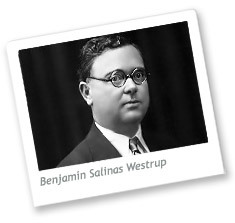
Benjamin Salinas Westrup: The Strange Turns of Life

In 1840, the young Queen of England, Victoria, married her first cousin, Albert of Saxe-Coburg and Gotha, nephew of Leopold of Saxe-Coburg and Gotha, King of the Belgians. Victoria and Albert were of the same age, both born in 1819.
Victoria came to the throne in the nick of time; she turned 18 in 1837, and thus became heir to the throne of England just a few months before the decease of her uncle, King William IV of England. Her father, Prince Edward, son of King George III, and heir to the throne, had died when she was a baby. Thus, Queen Victoria was a grand-daughter of King George III. Continue reading →

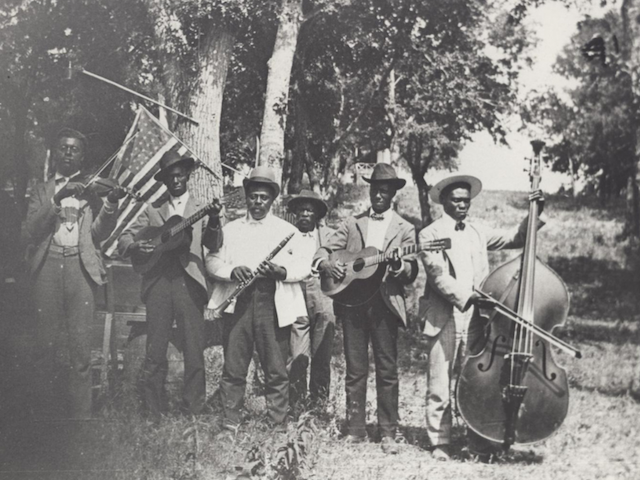
Juneteenth: Our Other Independence Day

Two and a half years after the Emancipation Proclamation, American slavery came to an end and a celebration of freedom was born

Since this article was first published in 2011, Juneteenth celebrations have attracted increased attention around the nation. According to the National Juneteenth Observance Foundation, 45 states and the District of Columbia had, by 2017, passed legislation officially recognizing the holiday. With the current unrest over the killing of another African American man at the hands of the police, the pervasive scars of the nation’s long history of enslavement and racism has again dominated the news. Protests across the country have brought renewed attention to the holiday, as has President Trump’s recent announcement of a campaign rally being held in Tulsa, itself the site of a horrific race massacre, on Juneteenth.

Amid all of this, not to mention the COVID-19 pandemic that is disproportionately affecting the country’s black population, Americans have even more reasons to continue learning about the roots of racism in American history. We must confront the great contradiction in our past—that a “nation conceived in liberty” was also born in shackles.
Continue reading →

Nancy Green ~ Aunt Jemima

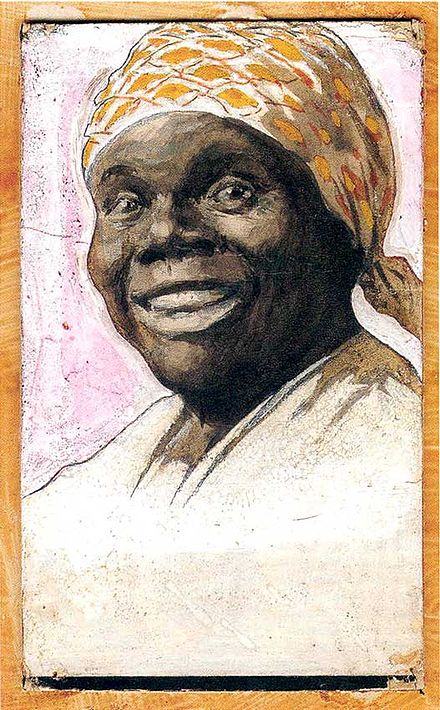
Portrait of Green as Aunt Jemima, by A. B. Frost

Nancy Green (November 17, 1834 – August 30, 1923 was a storyteller, cook, activist, and the first of several African-American models hired to promote a corporate trademark as “Aunt Jemima”.

Green was born into slavery on November 17, 1834, near Mount Sterling in Montgomery County, Kentucky. She was hired in 1890 by the R.T. Davis Milling Company in St. Joseph, Missouri, to represent “Aunt Jemima”, an advertising character named after a song from a minstrel show. Davis Milling had recently acquired the formula to a ready-mixed, self-rising pancake flour from St. Joseph Gazette editor Chris L. Rutt and Charles Underwood and were looking to employ an African-American woman as a Mammy archetype to promote their new product. In 1893, Green was introduced as Aunt Jemima at the World’s Columbian Exposition held in Chicago, where it was her job to operate a pancake-cooking display. Her amicable personality and talent as a cook for the Walker family, whose children grew up to become Chicago Circuit Judge Charles M. Walker and Dr. Samuel Walker helped establish a successful showing of the product, for which she received a medal and certificate from the Expo officials. Continue reading →

NH Dem Senator: Working-Class Parents Don’t Have Intelligence to Oversee Their Kids’ Educations

State Sen. Jeanne Dietsch (D-Peterborough)

Working-class parents without college degrees aren’t capable of overseeing their own children’s education, according to comments State Sen. Jeanne Dietsch (D-Peterborough) made during a House Education Committee hearing on Tuesday.

Dietsch was speaking on behalf of a Senate bill that would repeal a law allowing the state Board of Education to create an alternative program for granting graduation credits, which became Learn Everywhere.

“This idea of parental choice, that’s great if the parent is well-educated. There are some families that’s perfect for. But to make it available to everyone? No. I think you’re asking for a huge amount of trouble,” Dietsch said. Continue reading →

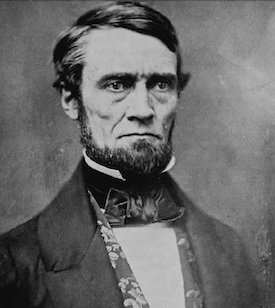
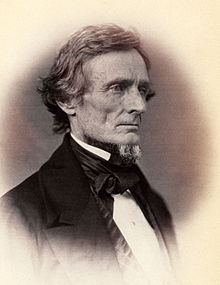
The Pardon of Jefferson Davis and the 14th Amendment

On October 17, 1978, President Jimmy Carter officially restored the full citizenship rights of former Confederate president Jefferson Davis, signing an act from Congress that ended a century-long dispute.

Davis is most remembered today as one of the leaders of the Confederacy, along with General Robert E. Lee. In 1976, Lee’s citizenship was restored by Congress, also about a century after Lee’s death after the Civil War. The restoration of Davis’ citizenship soon followed.

“In posthumously restoring the full rights of citizenship to Jefferson Davis, the Congress officially completes the long process of reconciliation that has reunited our people following the tragic conflict between the States,” the resolution read on October 17, 1978. Continue reading →