
 The Confederacy has been the excuse for some of today’s rioting, property destruction and grossly uninformed statements. Among the latter is the testimony before the House Armed Services Committee by the Chairman of the Joint Chiefs of Staff General Mark Milley in favor of renaming Confederate-named military bases. He said: “The Confederacy, the American Civil War, was fought, and it was an act of rebellion. It was an act of treason, at the time, against the Union, against the Stars and Stripes, against the U.S. Constitution.”
There are a few facts about our founding that should be acknowledged. Let’s start at the beginning, namely the American War of Independence (1775-1783), a war between Great Britain and its 13 colonies, which declared independence in July 1776. The peace agreement that ended the war is known as the Treaty of Paris signed by Benjamin Franklin, John Adams, John Jay and Henry Laurens and by British Commissioner Richard Oswald, on Sept. 3, 1783. Article I of the Treaty held that “New Hampshire, Massachusetts Bay, Rhode Island and Providence Plantations, Connecticut, New York, New Jersey, Pennsylvania, Delaware, Maryland, Virginia, North Carolina, South Carolina and Georgia, to be free sovereign and Independent States.” Continue reading

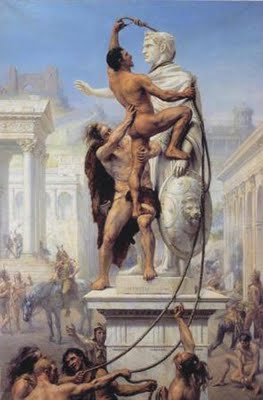 The examination the historical red flags that preceded crises dating back to the Roman Empire.
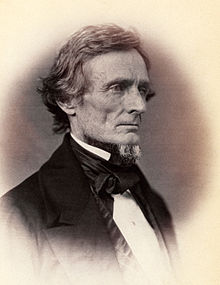 Regarding the War of Northern Aggression, Jefferson Davis once made an interesting statement. He said: “Our children may forget this war, but we cannot. The war came and now it must go on till the last man of this generation falls in his tracks, and his children seize his musket and fight our battle.”
 The Union Cavalry numbers during the first two years of the Civil War did not exceed 60,000 men. But yet 284,000 horses perished in the service of the Cavalry, few of them in battle. In the winter of 1863-1864 alone in the Union forces in Tennessee, 30,000 horses were lost. Why? Inadequate veterinary care. It wasn’t just “inadequate.” It was breathtakingly, completely absent.





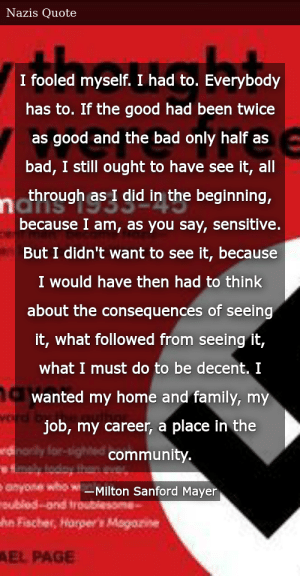 What no one seemed to notice,” said a colleague of mine, a philologist, “was the ever widening gap, after 1933, between the government and the people. Just think how very wide this gap was to begin with, here in Germany. And it became always wider. You know, it doesn’t make people close to their government to be told that this is a people’s government, a true democracy, or to be enrolled in civilian defense, or even to vote. All this has little, really nothing, to do with knowing one is governing.
 Last year, singling out screen legends such as Marilyn Monroe and Marlene Dietrich, who died alone, Bardot told Dalya Alberge: “The majority of great actresses met tragic ends. When I said goodbye to this job, to this life of opulence and glitter, images and adoration, the quest to be desired, I was saving my life.”
 Americans used to have great reverence for the spoken word. Before radio and TV, there were political speeches and the great orators were prized for their ability to move audiences to laughter, to tears, or to rage.