Opinion: Celebrating Graduation and the Benefits of Attending Public Schools

As parents around the country celebrate graduation, everyone relives the good, bad, and funny moments of high school. But what are the benefits of attending public schools? There are more than you might think.

My son recently graduated from public school. The graduation ceremony brought tears to our eyes. We were proud of his accomplishments. Graduation is a milestone moment in the lives of parents and children. We remember when they were born and marvel about how they have grown. But what are the benefits of attending public schools, especially when there are so many viable educational choices? Continue reading →

Florida school dumps common core then skyrockets to number one in English Language Arts, with 90 percent scoring proficient

There is a reason that people have learned reading, writing and arithmetic in generally the same way over the years, and that’s because the tried-and-true traditional methods work. That’s why many people wondered what the real agenda of the Common Core national standards were when the Obama administration started pushing for it so relentlessly. This ridiculous set of educational standards has left many students and parents baffled and frustrated, and it’s believed to be a key reason that American kids are lagging behind other nations in academic performance. What would happen if we got rid of it entirely? If the results gained by one Florida school are any indication, we would likely all be much better off.

Mason Classical Academy, a charter school in Naples, Florida, prides itself on providing a classical education, which it believes brings about “superior educational results” – and leading the county in English Language Arts is proof they’re on the right track. Continue reading →

The Danger of “Public” Education

The key issue in the entire discussion is simply this: shall the parent or the State be the overseer of the child?

An essential feature of human life is that, for many years, the child is relatively helpless, that his powers of providing for himself mature late. Until these powers are fully developed he cannot act completely for himself as a responsible individual. He must be under tutelage. This tutelage is a complex and difficult task. From an infancy of complete dependence and subjection to adults, the child must grow up gradually to the status of an independent adult. The question is under whose guidance, and virtual “ownership” the child should be: his parents’ or the State’s? There is no third, or middle, ground in this issue. Some party must control, and no one suggests that some individual third party have authority to seize the child and rear it. Continue reading →

Our Public School System Isn’t Producing Education Equality

All across America, preparations are underway for high school graduation. It’s a glorious time, representing both a milestone and a gateway to adulthood.

But missing from this year’s ceremonies are more than one million kids who dropped out and will not be attending graduation day.

The future those high school dropouts face is chilling. They will have a much harder time getting a job and will earn much less than those who did graduate. They’re also more likely to commit a crime and more likely to be the victim of one.

In short, many of them face a life that will be so much more difficult—all because they could not or chose not to finish high school.

The consequences of this crisis are especially evident in my community. Today, more than half of all African-American students in many large U.S. cities don’t graduate from high school. Think about that.

And those kids aren’t just dropping out—they’re escaping.

According to the National Assessment of Educational Progress, schools that serve majority-minority communities have the worst performance, the highest crime rates, and the largest achievement gaps. More than half of all African-American students in many large U.S. cities do not graduate from high school. Continue reading →

Homeschool is Booming, New Study Shows

New data compiled by a Boston-based a public policy group reveals that homeschooling has gained in popularity and reach in recent decades.

A report issued this week by The Pioneer Institute, a Boston-based a public policy think tank, sheds light on the rapid growth and diversity of the U.S. homeschooling population.

Co-authored by William Heuer and William Donovan, the comprehensive white paper explains that despite a paucity of support from government officials–and outright opposition by the nation’s largest teachers’ union–homeschooling has gained in both popularity and reach over the past several decades. Continue reading →

September 15, 1862: Antietam Creek, Maryland

Did battle, and US future, hang on thread of fate?

Originally Published on the 150th anniversary of the Battle at Antietam Creek.

SHARPSBURG, Md. ­ – From as far away as Minnesota, Colorado and Ohio they came, more than 30 members of the Bloss and Mitchell families who converged on the hallowed Civil War fighting grounds of rural Maryland.

John McKnight Bloss, now 81, had just parked his RV at a campground when he tried to sum up what this gathering of his clan was about. He’s been researching his namesake great-grandfather, who was wounded four times during Civil War battles, including the epic fight along meandering Antietam Creek 150 years ago – and he wanted the younger generation to “understand the sacrifices that were made.”

Robert Mitchell Menuet spoke proudly of Barton Mitchell, his ancestor who served alongside John Bloss in the 27th Indiana Volunteer Infantry and suffered a life-shortening wound at Antietam – one of the 23,000 casualties that made the battle on Sept. 17, 1862, the single bloodiest day in U.S. history.

But something more particular drew the descendants to Maryland. Continue reading →

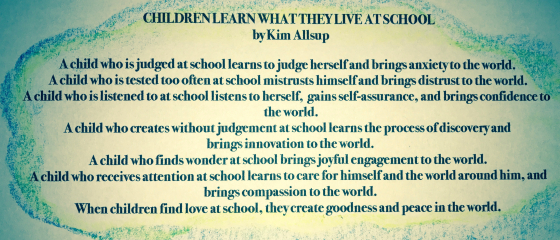
Children Learn What They Live At School

“Dreams are extremely important. You can’t do it unless you can imagine it.” ~ George Lucas

Let’s dream about public schools of the future where children are motivated by wonder, curiosity and compassion rather than the wish to do well on tests. My book, A Gift of Wonder, A True Story Showing School As It Should Be, is both a true story about a school that works and a window into the future of education.

(Click here to order your copy of A Gift of Wonder)

Kim Allsup ~ June 14, 2017

The best reason not to home-school your children

After conducting a multi-center, phase-3, double-blind, placebo controlled, independently reviewed study, encompassing 39 countries, various undersea kingdoms, and the moon, I’ve concluded that the best reason parents shouldn’t home-school their children is:

They can’t.

They can’t, because the public education they received was so wan and thin and bereft of substance, they’re unfit to teach.

For those parents who did receive a decent education, and who can handle the schedule, home schooling is a rational decision.

At minimum, it removes them and their kids from a system designed to impart values, values that should be taught at home.

Sex. Politics. Mental health. Vaccination. Gender. Contraception. Abortion. Diversity. These are a few issues schools now consider “public.” Schools become society’s parents. It takes a village. Their kind of village. They run it. They own it. “For the children.” Continue reading →

Teacher Resignation Letters Show Why Public School Teachers (Myself Included) Quit

I became a conservative after a year teaching 4th grade at a public school in the inner city. Before that, I probably would have said I was a liberal. I wasn’t really interested in politics, but all my friends were liberals, so I figured I must be one too.

When I got my teacher’s license, the first thing I did was go looking for the most challenging teaching situation I could find. I had just completed a two-year Masters program at a prestigious teaching school in New York City and was filled with idealism, determination, and a cocky conviction that I would succeed where so many others had failed. (Think Michelle Pfeiffer in Dangerous Minds.) Continue reading →

“Bad Schools” Will Just Not Die

If a prize were awarded for the worst policy idea, one that would waste billions in some futile quest for the impossible, the indisputable winner would be uplifting the academic bottom by fixing their “bad schools.” It is a seductive idea that never seems to die despite repeated failures; it even seduces free-market conservatives infatuated with school choice remedies. What can possibly explain such stupidity?

Let’s start with the underlying “logic” of this doomed quest—the belief that low-IQ, academically unmotivated youngsters prone to classroom disorder attending schools disinclined to impose discipline can achieve reading and mathematical proficiency by tinkering with school environments. Moreover, that these troubled youngsters already attend well-financed schools with perfectly adequate facilities, small classes, state-certified teachers, ample pedagogical specialists and everything else that physically defines a “good school” is hardly acknowledged. Nor is there any past evidence that this fix-the-environment approach, everything from unscrewing chairs from the floor to cutting-edge technology, has ever moved the academic proficiency needle.

But hope springs eternal and the fantasy’s latest installment was President Obama’s $7 billion dollar failed School Improvement Grants Program whose aim, according to Arne Duncan Obama’s Secretary of Education from 2009 to 2016, was to “turn around” 1000 schools per year over five years (according to the DOE rhetoric, this initiative was to “…implement innovative, effective, ambitious, comprehensive, and locally driven strategies”). Alas, whether calibrated by test scores, graduation rates or college enrollment, nothing helped. And keep in mind that the multi-billion dollar nostrum has been around since the George W. Bush era though the Obama administration significantly increased funding.
Continue reading →

12 Things You Just Don’t See In Schools Anymore…

Does the posting of this have any benefit in today’s Fed-ucation world? I don’t know – but it’s fun to look back. How many of you participated in these activities? Ooh yes – I had my turn writing on the blackboard – and it wasn’t because I was a good boy. Yes – we carried books to and from school – not a pad or cell-phone nor a laptop.

We learned at an early age how to use card files to research and locate books – which we READ! Prayer? The pledge? Absoutely and so much more.

Every era has a different feel and smell. In our school days, the smells of chalk dust and library books were a real part of our education. Classrooms today have changed so much since we were in school. A few things we wouldn’t miss, but others are a part of our memories in big ways, even the little things! Here a few of the things we did in school that simply aren’t a part of most children’s days now.  Continue reading →

Williams: Rewriting American History

“The job of tyrants and busybodies is never done. When they accomplish one goal, they move their agenda to something else. If we Americans give them an inch, they’ll take a yard. So I say, don’t give them an inch in the first place.” ~ Walter Williams

Walter Williams, Economist

George Orwell said, “The most effective way to destroy people is to deny and obliterate their own understanding of their history.” In the former USSR, censorship, rewriting of history and eliminating undesirable people became part of Soviets’ effort to ensure that the correct ideological and political spin was put on their history. Deviation from official propaganda was punished by confinement in labor camps and execution.

Today there are efforts to rewrite history in the U.S., albeit the punishment is not so draconian as that in the Soviet Union. New Orleans Mayor Mitch Landrieu had a Confederate Gen. Robert E. Lee monument removed last month. Former Memphis Mayor A C Wharton wanted the statue of Confederate Lt. Gen. Nathan Bedford Forrest, as well as the graves of Forrest and his wife, removed from the city park. In Richmond, Virginia, there have been calls for the removal of the Monument Avenue statues of Confederate President Jefferson Davis and Gens. Robert E. Lee, Stonewall Jackson and J.E.B. Stuart. It’s not only Confederate statues that have come under attack. Just by having the name of a Confederate, such as J.E.B. Stuart High School in Falls Church, Virginia, brings up calls for a name change. These history rewriters have enjoyed nearly total success in getting the Confederate flag removed from state capitol grounds and other public places. Continue reading →

REDUX: Our Schools, Dumb and Dumber

The following column by Alan Caruba was originally published by Kettle Moraine Publications on August 29, 2010, however it won’t be long before the end of summer, and the victims of the Fed-ucation Holocaust will be returning to the den once more. Alan’s words are as direct and point-on as they were so many years ago. ~ J.B.

The Blood-Sucking Educator

As the nation’s children return to elementary and secondary schools, it is increasingly essential that their parents and communities coast to coast realize how poorly served they are and how their learning environment is increasingly tainted by a socialist agenda.

Our nation’s schools have long been factories of boredom, centers of academic incompetence. High school graduation rates have been in a fairly steady decline. At its peak in 1969, the rate was 77 percent. By 2007 it was 68.8 percent.

In mid-August, The Wall Street Journal reported that “New data show that fewer than 25% of 2010 graduates who took the ACT college-entrance exam possessed the academic skills necessary to pass entry-level courses, despite modest gains in college-readiness among U.S. high school students in the last few years.”

What caught my eye was a quote from Jack Jennings, president of the Center on Education Policy, a nonpartisan research organization in Washington, who said that “if our kids aren’t dropping out physically, they are dropping out mentally.” Continue reading →


How Education-Funding Formulas Target Poor Kids

Thirty-five states have policies engineered toward sending extra dollars to needy districts. But not all are successful.

Students at Little Fort Elementary School in Waukegan, Illinois. Illinois is one of three states where school funding is regressive overall. (Kamil Krzaczynski / AP)

Districts serving many low-income children in New Jersey receive nearly $5,000 more per pupil from the state government than districts with a fewer poor students. If that same district was located in Montana, it would only receive an extra $18 per student from the state. Despite the fact that the majority of states have education funding formulas meant to target low-income students, the effectiveness of this targeting varies widely around the country. Continue reading →

Benson: Socialist Teachers Unions

The NEA – the Ultimate Trojan Horse

The National Education Association meets every year for a big national convention in some city or other and teachers from all over the country show up for this event.

An agenda is usually presented showing all the things nationally that the NEA is either for or against. In the past several years they have presented agendas that Hugo Chavez, Marxist dictator of Venezuela, would love. Many of the issues they choose to address have little or nothing to do with education, but everything to do with their leftist worldview.

While many have heard of the NEA they don’t have any idea of how long it has been around or what it really does, only that many of their kids’ teachers belong to it, and the compliant media, when it reports on NEA conventions, is not about to give out anymore real information than it has to. In all fairness to public school teachers, there are some that are not in favor of what this “teachers union” does, but their opposition is generally ignored or ridiculed. Continue reading →

Education Failure Is the New Success

If one compiled a list of massive cultural engineering projects, America’s effort to close race-related academic achievement gaps would be the most ambitious. For over a half century we have spent tens of billions, devised scores of remediation schemes, and pursued legal solutions galore, all to no avail. Even conservatives normally hostile to social engineering have joined the quest.

What makes this enterprise remarkable is that every single putative nostrum entails zero effort by the students themselves as if those targeted lacked any agency for academic uplift. To use bizarre phraseology, this is passivity on steroids. This is not to suggest that if math-challenged junior got religion and buckled down he could master stochastic calculus; rather, in places like Baltimore where schools spend an average of $16,000 per student and barely any can meet minimal English and math standards, room exists for improvement . Continue reading →

New Social Justice Math Class Will Teach Your Kids About “Inequity, Poverty, and Privilege”

There’s a good reason why some college departments are riddled with social justice ideologues, and others are not. It’s because these beliefs are completely illogical, so they can only thrive in subjects that are open to interpretation. So if you went to college and took a class for liberal arts, gender studies, or sociology, you’re far more likely to run into politically correct nonsense than if you took a class in say, astrophysics. It’s hard to insert emotionally charged drivel into a subject that is relatively cut and dry. Continue reading →

75% of black California boys don’t meet state reading standards

Across ethnicities and economic status, girls outperform boys on English in standardized tests

Three of four African-American boys in California classrooms failed to meet reading and writing standards on the most recent round of testing, according to data obtained from the state Department of Education and analyzed by CALmatters.

More than half of black boys scored in the lowest category on the English portion of the test, trailing their female counterparts. The disparity reflects a stubbornly persistent gender gap in reading and writing scores that stretches across ethnic groups. Continue reading →