Publisher’s Note: As we reopen Le Metropolis Café we are excited to post the following lengthy dissertation written by John Adams, an American patriot who would some years later serve as the second President of the United States (1797–1801) and the first Vice President (1789–97). He was a lawyer, diplomat, statesman, political theorist, and, as a Founding Father, a leader of the movement for American independence from Great Britain. The following was written by him some years before all of these events transpired. ~ Jeffrey Bennett, Publisher and frustrated Historian. Oct. 5, 2017

John Adams, Patriot
“Ignorance and inconsideration are the two great causes of the ruin of mankind.” This is an observation of Dr. Tillotson, with relation to the interest of his fellow men in a future and immortal state. But it is of equal truth and importance if applied to the happiness of men in society, on this side the grave. In the earliest ages of the world, absolute monarchy seems to have been the universal form of government. Kings, and a few of their great counselors and captains, exercised a cruel tyranny over the people, who held a rank in the scale of intelligence, in those days, but little higher than the camels and elephants that carried them and their engines to war.
By what causes it was brought to pass, that the people in the middle ages became more intelligent in general, would not, perhaps, be possible in these days to discover. But the fact is certain; and wherever a general knowledge and sensibility have prevailed among the people, arbitrary government and every kind of oppression have lessened and disappeared in proportion. Man has certainly an exalted soul; and the same principle in human nature, — that aspiring, noble principle founded in benevolence, and cherished by knowledge; I mean the love of power, which has been so often the cause of slavery, — has, whenever freedom has existed, been the cause of freedom. If it is this principle that has always prompted the princes and nobles of the earth, by every species of fraud and violence to shake off all the limitations of their power, it is the same that has always stimulated the common people to aspire at independency, and to endeavor at confining the power of the great within the limits of equity and reason. Continue reading →
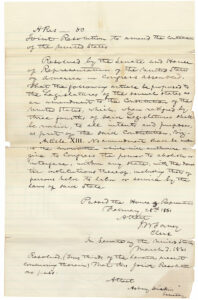 In December of 1860, many Republicans were beginning to take the secession movement seriously and felt that a compromise needed to be reached in order to keep the Upper South, including states like North Carolina and Tennessee, from seceding. For this reason, two committees were convened by Congress for the express purpose of dealing with proposals aimed at averting the secession crisis. The House of Representative’s “Committee of Thirty-Three” was formed on 4 December, 1860, the day after the second session of the thirty-sixth Congress convened. This committee took its name from the thirty-three Representatives, one from each state, that were appointed to its seats. The committee, chaired by Thomas Corwin of Ohio, met for the first time on 11 December. The Senate’s “Committee of Thirteen” was created on 18 December, and like the Committee of Thirty-Three, took its name from the number of seats assigned to it. On 20 December, Vice-President John C. Breckinridge appointed thirteen Senators to the committee, and they met for the first time that very day. Continue reading
  On May 22, 1856, South Carolina Representatives Preston Brooks and Laurence Keitt, along with Virginia Representative Henry Edmundson, made a visit to the Senate chamber. When they arrived, the balcony above the chamber still contained some straggling observers, mostly wives of senators. Since Brooks and Keitt were southern gentlemen, they respectfully waited for the ladies to leave.
 We all want the best for our kids. Because of this desire, it’s quite discouraging to see when efforts to boost progress in reading, math, and other subjects flatline in schools across the country, as the chart below shows.
 The local “education” improvement efforts follow in the footsteps of multiple national “education” strategy programs over the decades, e.g. Dewey’s Progressivism, School to Work, Goals 2000, No Child Left Behind, Common Core, and for good reason. It comes from a Consulting company, Cambridge Strategies, headed by Kevin Castner who in 2010 served as a Race to the Top (Obama’s version of education reform) Peer Review Panelist for the U.S. Department of Education.
 Teachers across the country retire, their pensions are being subsidized by newly hired teachers to a surprising degree. Teachers’ pension plans have always rewarded long-serving veterans at the expense of short-termers. But now, as more and more plans develop shortfalls, states have been imposing cost-cutting measures, and recent research shows that the newest hires are bearing the brunt of the changes, raising questions of fairness.
  By July of 1862, the Union was not faring so well against the Confederacy in its War of Aggression. Although they had won half again as many battles the Southerners, winning thirty-nine battles to the South’s twenty-six, the Southerners had fought them to a stand-still nineteen times, despite being outnumbered by two to one. Many in the North were beginning to grumble about the war, and morale, along with support for the war, was beginning to wane, and sympathy for the Southern cause was building in Western Europe.
  Robert Chandler in his 2008 book SHADOW WORLD tells how Plato explained the differences between images and reality in their simplest and perhaps purest form some 2,400 years ago. He selected the shadows made by a fire in a cave to explain the difference between what we see and the reality surrounding us in the sunlight outside the cave. Shadows are only imitations of really living things, the Greek philosopher observed. The shadows on the wall of the cave present the appearance of material things, not their true nature.
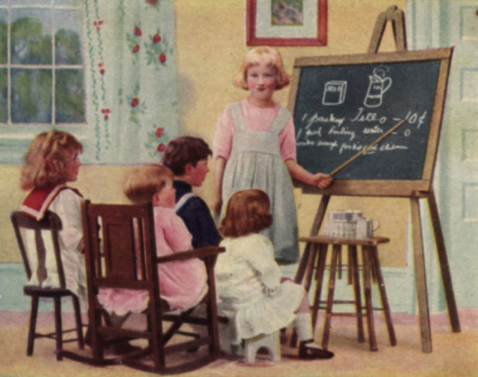 Though there’s some debate about the exact figure, one thing is certain: Homeschooling families nationwide are saving taxpayers a ton of money.
 Every parent wants the best possible education for their child–one that fits their child’s unique needs, challenges them to grow, and equips them to succeed. But there are so many options–public, private, and charter schools, plus homeschooling and online schooling–that it’s easy for parents to feel overwhelmed and, well, undereducated about the choices. What’s more, while one schooling option may be right for one child, it may be challenging for another. And sometimes the same child will thrive in one environment in elementary school but falter in that same environment in middle school.
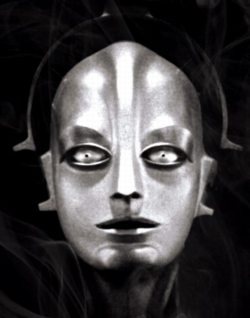 ~ Foreword ~
 My teaching bag of tricks is full of stories, lots of stories— biographies that are a window into history, stories to teach the alphabet, stories that break down the complexity of a math process and metaphoric stories such as parables and fables that spark thinking.
 This essay is about a long-forgotten New Yorker who served in his state’s legislature and twice as governor, then nearly became President of the United States. Much respected, even beloved by many in his day, his name was Horatio Seymour. He deserves to be dusted off and appreciated now, almost 130 years since his death. But first, some context.