Comparing US Presidents and Roman Emperors
Leave a reply

 I grew up in a little town about 25 miles north of Chicago called Northbrook, Ilinois at a time when everyone treated each other with respect. We didn’t eat a lot of fast food. We drank Kool-aid, ate lunch meat sandwiches, PB&J sandwiches, grilled cheese sandwiches, hot dogs, but mostly home made meal such as meatloaf, fried chicken, roast beef & pork chops, black eye peas, snap peas…
We grew up during a time when we would gather glass bottles to take to the store and use the deposit money to buy penny candy. (We even got a brown paper bag to put the candy in). You sure could get a lot for 25 cents. We went outside to play games, rode bikes, jumped rope and raced against sibling played hide and seek, Red Rover, Red light green light, mother may I, kick the can and yes the games got more daring as we grew…There was no bottled water, no microwave or cable tv, no cell phones, no hair straighteners… Continue reading

Homeschooling parents who learn alongside their children often share their enthusiasm as well. (LightField Studios/Shutterstock)
We’ve digitalized schools, but students are doing worse than ever. Here’s how it happened and why some parents and teachers are pushing for a return to traditional learning.
Americans love a good success story, especially one built from failures and obstacles overcome.
Think of Edison and his thousands of attempts to make a light bulb or of Abraham Lincoln with the string of political defeats that preceded his presidency. Their dogged perseverance has inspired countless others to keep going when the going gets tough.
Less noted are the successes that breed failure. Continue reading
 Despite the rapid pace of the digital age, it’s still too soon to toss the paper and pen. Actually, you may never want to stop writing for good as long as you want to further develop your brain.
In an age of keyboards and touch-screens, some might argue that teaching cursive is a vestigial nicety in today’s classrooms. Even handwriting, much less cursive writing, is neglected in the national curriculum guidelines supported by 45 states… Continue reading
 I never took “social studies.” To this day, I’m not really sure what it even is! But every year when we took the state-standardized test as homeschoolers, my scores – as well as those of my siblings – came back in the 90th percentile or higher for all subjects, including social studies. This had nothing to do with luck or even smarts, but it had everything to do with the fact that we didn’t waste time on the social studies curriculum taught in schools in the first place.
If we were finishing up the school year in the spring and encountered an unseasonably warm day, we wouldn’t even crack open the books that day. As homeschoolers, we didn’t take off school for the bad weather, we took off for the good weather. We started our semester later and ended it earlier than our public school counterparts. Continue reading
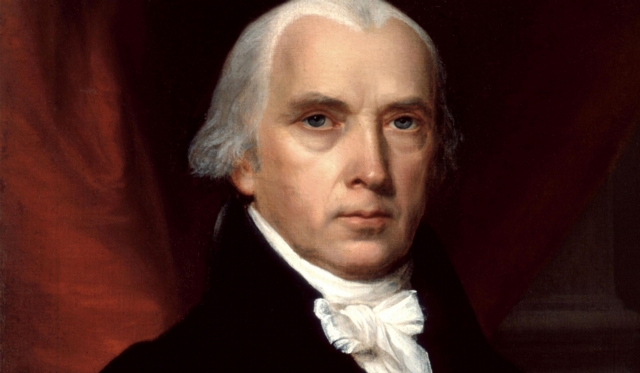
Portrait of James Madison, circa 1805–1807, by Gilbert Stuart. James Madison, originally a Federalist, worked hard to ensure that Antifederalists’ complaints about the Constitution would be addressed.
Less than three years after the Treaty of Paris ended America’s War for Independence in 1783, the infant nation still struggled to find its footing. Great Britain’s overreach of power – its writs of assistance, quartering of troops, and lack of jury trials – was still fresh in Americans’ memories, making many wary of concentrating too much authority in a centralized government. Yet it had become clear that the new nation’s Articles of Confederation were too weak to command order among the 13 states. Something had to be done. Continue reading
 The fire had burned down to a bed of glowing coals that night, the way fires do when the wood has settled into embers and the heat rises steady and quiet. My grandkids sat around me in a loose circle, wrapped in blankets, their faces flickering with amber light, their eyes wide the way young eyes get when they sense that the old man is about to say something he’s never said before. The cicadas hummed in the trees, and the air smelled of maple and river birch smoke, and for a moment I felt the years folding in on themselves – all the decades I’ve lived in Murfreesboro, all the changes I’ve watched come and go, all the things I’ve held in my chest because no one seemed to want to hear them.
Nights like this don’t come often anymore – nights when the world slows down long enough for an old man to speak and for children to listen… Continue reading
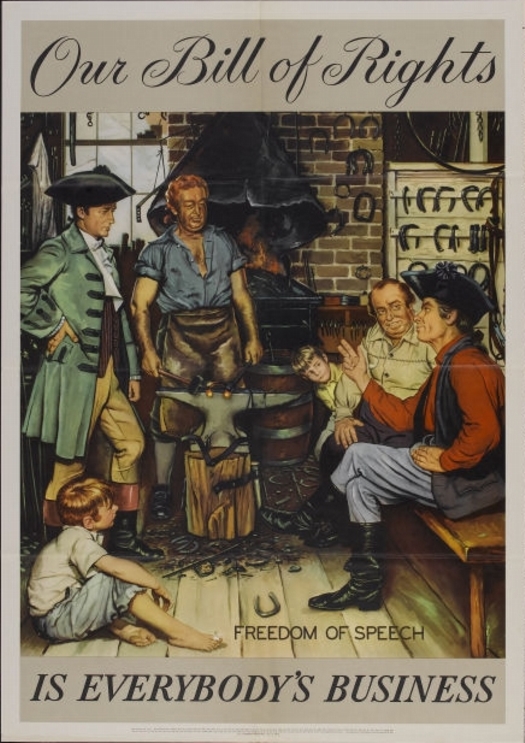 Most Americans have no idea their state has a constitution. They cannot name a single right it protects. Ask where their rights come from, and they will either plead the fifth or point to the federal Bill of Rights. What they do not know is that colonies first, then states, had declarations of rights before the federal government existed, often more expansive than anything the federal document would guarantee. Continue reading
 Parents of school-age children often see the same puzzle at home and at school: a capable kid hesitates, melts down over mistakes, or waits to be rescued. The tension is real, adult support can steady children’s emotional development, but too much steering can quietly teach doubt. Child self-confidence matters because it becomes the engine behind lifelong success traits like persistence, decision-making, and healthy risk-taking. With the right parental support strategies, confidence grows into everyday independence. Continue reading
 Americans today have reached unprecedented heights of prosperity, but our economic system rests on a foundation that was built centuries ago under the direction of the nation’s first president, George Washington.
“Not unlike our political form of government, the economic transformation Washington put in place was neither preordained nor inevitable,” historian Charles Ansary writes in his biography, “George Washington: Dealmaker in Chief.”
The prosperity that Americans enjoy today is rather the product of the decisions, protocols, and precedents established during Washington’s presidency, which set a path for future administrations to follow. Continue reading
Homeschooling parents who learn alongside their children often share their enthusiasm as well. (LightField Studios/Shutterstock)
Single parents, especially working caregivers and educators balancing lesson plans, grading, and home life, often carry a load that rarely fits neatly on a calendar. The core tension is constant: the emotional challenges of parenting don’t pause when the paycheck is tight, and the financial struggles in single parenthood don’t wait for a convenient moment.
Daily parenting responsibilities stack up fast, turning ordinary decisions into high-stakes choices and small setbacks into single-parent stress. Naming these child-rearing obstacles matters because it replaces guilt with clarity and makes room for steadier, more workable days. Continue reading
 Once again, a commitment made by President Trump and the congressional candidates who rode his coat tails and campaigned on his MAGA platform has gone unfulfilled. In fact, they’ve done the exact opposite.
Many of us voted to “Make America Great Again,” thinking that it included getting the federal government out of education. But the recent increased funding and continuation of the Department of Education is doing just the opposite.
As a former member of the Colorado State Board of Education, I witnessed firsthand how the flood of federal dollars never translated into meaningful academic improvements. Instead, it mostly funded bureaucratic programs, trendy initiatives and endless compliance requirements that did little or nothing to boost actual classroom learning or student achievement. Continue reading
 While Emily Bute isn’t a mom yet, she has already made one decision for her future kids: she will not be sending them to public school.
As a special education teacher in the public school system herself, she said she has seen first hand how the ‘system does not address the needs’ of children.
Bute, based in Oahu, Hawaii, recently went viral on TikTok after she broke down all the reasons why she has decided that she will homeschool her kids when she has them. Continue reading
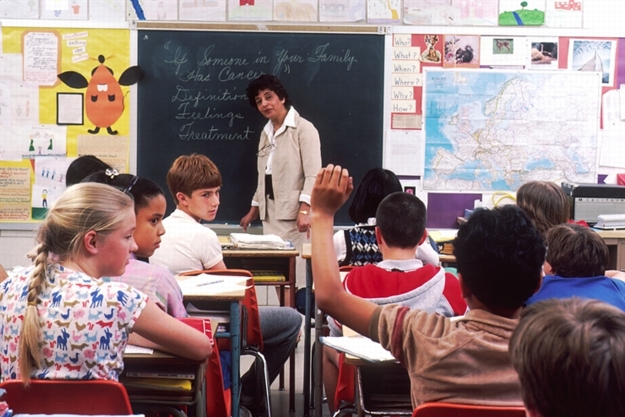 I was conversing with an 80-year-old neighbor recently who taught and coached for decades in public schools in New York City and here in Virginia. When I mentioned having taught seminars in literature, history, and Latin to homeschoolers, he instantly brought up socialization, a word I’ve heard linked to homeschoolers since my wife and I began educating our oldest child at home 40 years ago.
“Homeschoolers shouldn’t go to public school when they get older,” he said, and I’m paraphrasing. “They’ve missed out on socialization. They’ve been with their moms, and then they’re put into school where there’s bullying and cursing. It even starts in kindergarten now around here, from what friends tell me. They’re just not equipped socially to handle that.”
As I’ve done on many other occasions, I defended homeschoolers against this supposed lack of social skills, pointing out that while they spend part of their days with their mothers or fathers and siblings, they also had friends, interacted with various adults, and participated in activities outside the home, like ballet, soccer, seminars like mine, and dual-enrollment classes at the community college.
But what I wanted to do was burst out laughing. Why on earth would any parent want their children “socialized” in a culture of bullying and obscenities? Continue reading
 Over the past sixty years, there has been a significant shift, in how historians perceive President Dwight D. Eisenhower. In a survey conducted in 1962, Eisenhower was ranked 22nd among Presidents, considered just an average leader, comparable to Chester A. Arthur, and slightly superior to Andrew Johnson. However, by the 1980s, his standing had risen to 11th place, and by 1994, he had climbed to 8th. This position has remained consistent, as evidenced by current polls of presidential historians. Among Presidents who served in the last 75 years, he was surpassed in ranking only by Franklin D. Roosevelt and Harry S. Truman. So, who was the real Dwight D. Eisenhower? Continue reading
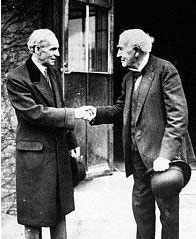
Thomas Edison and Henry Ford
Into the chilled October night four figures cut through the dark. Over the railroad tracks, down the dirt streets, past the preserved homes and the silent shops, they quietly made their way to a group of buildings just ahead.
The short elderly man in the middle seemed to be the center of their concern. As the group ascended the stairs inside the long wooden building one man held his arm in assistance. At the top of the stairs another helped him out of his coat. The third led him to a seat at the end of a long work bench.
In front of his chair there had been erected a plank of wood about six feet high and six inches across. On it were tubes and wires running from the top to the floor. A glass globe lay on the workbench.
The old man paused for a moment, brushed the lock of white hair from his eyes and began to work. One of the men assisted as the other two watched with smiles and intensity for the work being completed. Continue reading
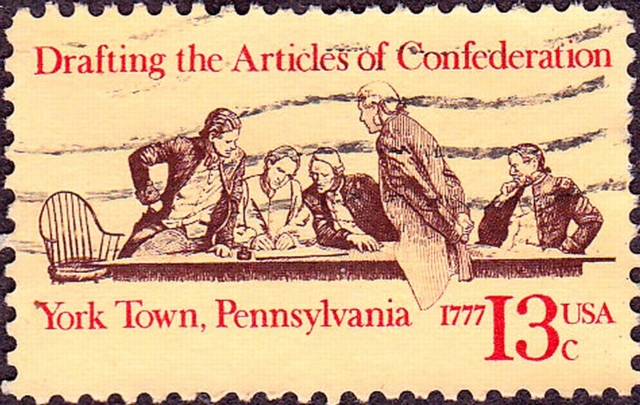 It is taken, in many cases, to be fact that the reason the Constitutional Convention was called and that the Constitution was ratified was because of the failure of the Articles of Confederation system. The folks at Heritage have made their position clear:
The first plan the Framers tried after declaring independence was called the Articles of Confederation. The government that the Articles created failed because it was too weak to coordinate national policy among states with different priorities. Continue reading
 Across the country, teachers are sounding the alarm about a new kind of gap in the classroom: kids who can code on a tablet but cannot tie their shoes, write a legible sentence, or remember their own phone number. The viral stories are piling up, and so is the parental anxiety, as families realize these “basic” skills are not guaranteed anymore. Underneath the panic is a harder question, though, about what schools and homes are actually prioritizing in 2026. Continue reading
 Benjamin Franklin, a Founding Father, believed money could not bring lasting happiness. His life showed that desire grows with wealth, not contentment. Franklin, from modest beginnings, achieved great influence through self-education and public service. He established institutions and made scientific discoveries. His focus was on purpose, learning, and self-control, not accumulation. This perspective remains relevant today. Continue reading