“It was necessary to put the South at a moral disadvantage by transforming the contest from a war waged against states fighting for their independence into a war waged against states fighting for the maintenance and extension of slavery…and the world, it might be hoped, would see it as a moral war, not a political; and the sympathy of nations would begin to run for the North, not for the South.” ~ Woodrow Wilson, History of the American People, 1902
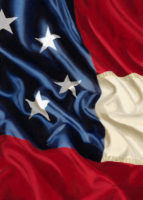
Adopted as the first flag of the Confederate States of America by the provisional congress on March 4, 1861, and despite its official use for over two years, this flag was never formally adopted by law because it was to be used in a flag-raising ceremony within two hours of being adopted and the congress neglected to enact a flag law. It was the original “Stars and Bars” and eventually grew to 13 stars.
How many of you remember back in grade school when they would give you a sentence with a blank in it, then provide you with choices to fill in the blank correctly? I want to try something similar, except I’ll never know how you answer. So fill in the following sentence with either “federal” or “national”: In the United States the __________ government is located in Washington, D.C.
I’m sure there were a few of you who thought to yourselves that this was a stupid exercise as they both mean the same thing. Well, that’s the entire point of this exercise, because they don’t mean the same thing.
Federalism refers to a system in which distinct sovereign entities form together in a confederation with power shared by the federal and State/local governments. Each has their own distinct spheres of operation in which they exercise jurisdiction and sovereignty.
In Federalist 45 James Madison declares our system to of a federal nature as follows, “The powers delegated by the proposed Constitution to the federal government, are few and defined. Those which are to remain in the State governments are numerous and indefinite. The former will be exercised principally on external objects, as war, peace, negotiation, and foreign commerce; with which last the power of taxation will, for the most part, be connected. The powers reserved to the several States will extend to all the objects which, in the ordinary course of affairs, concern the lives, liberties, and properties of the people, and the internal order, improvement, and prosperity of the State.”
Continue reading →

 According to the Nation’s Report Card, only 27 percent of 8th graders attain proficiency in writing. But no problem, right? They’re just leaving middle school. Give them a few years under the instruction of high school English instructors and all will be well.
 ~ Forewords ~
 According to a recent article in the British Psychological Society’s Research Digest, preschool-age children have a special talent for memorizing and remembering rhymes. As the Digest explains, a recent study found that, compared to their parents and other older adults, young children are able to recall “nearly twice as many correct words” from the rhyming stories they hear, all while making “far fewer errors.”

 I’m sure it’s a different list of “behinds” for your child, but they’re there nonetheless, and the pressure to make sure your child isn’t behind the other kids weighs on you like a ton of bricks. We all want our kids to show up to kindergarten like an old, learned professor: “Ah yes, the alphabet.”
 Here’s a pop quiz for all you students at every level. It doesn’t matter whether you’re in school today or if you’re simply a student of life (as we all should be until we die). Since Jimmy Carter brought us the Department of Education, what has been the positive impact it’s had on our students, teachers, parents, or communities?
 As an advocate for education reform for the past 35 years, a co-founder of a very successful charter school, a lifelong Republican, and the most recent past president of the Arizona State Board of Education, I have never been more embarrassed, outraged, disappointed, and angry to call myself a Republican. How on earth do the Republicans in the state Legislature who voted for the Empowerment Scholarship Account (voucher) bill, or our governor, who signed it, look in the mirror and in good faith, not understand what they have just done.
 President Donald Trump signed an executive order on April 26 that is ostensibly aimed at curtailing unlawful federal meddling in K-12 education across America. But it may not actually accomplish that much, depending on how top education officials implement it.

 Although it is often viewed as a radically new idea, the vast majority of parents in this country have been participating in a system of school choice for years.
 New Orleans is the nation’s largest and most complete experiment in charter schools. After Hurricane Katrina, the State of Louisiaana took control of public schools in New Orleans, and launched a nearly complete transformation of a public school system into a system of charter schools. Though there are spots of improvement in the New Orleans charter system, major problems remain.
 Stephen Litt has been conducting science experiments since he was in first grade. Every year, the projects became more and more complicated — until finally, as a 7th grader, he came across something that gained national attention.
 Arizona public schools will get new letter-grade ratings for the first time in three years this fall, and the state will calculate them in ways both different and similar.
 One of the most effective tools our elite use to get their way is education. Or let me rephrase that, indoctrination. We see all through our so called ‘education system’ that what the elites want taught is not really for the benefit of the American people. It is for the benefit of the global society.
 TAMPA, FL—Liberty Counsel sent a
 For years, we have watched American history disappear in academe. It turns out that we’re not the only ones who have noticed.
 For those of us old enough to remember its beginnings, the United Negro College Fund’s iconic “A mind is a terrible thing to waste” campaign is still haunting. It began in 1972 with images of black students shut out of college classrooms, and ended with an almost undeniable appeal: donate to UNCF so that black kids can get an education.
 The Los Angeles teacher unions, the L.A. Unified School District bureaucrats, and all their court eunuchs in Sacramento know they can’t take on charter schools directly anymore. They’re just too popular. So they have cooked up a way to stop them through death by a thousand cuts. Through a series of proposed regulations, they now mean to make charter schools every bit as horrible as public schools. Since they can’t beat them, it’s all about dragging their rivals down to their own level.