
Painting by John Trumbull
Years before the Son’s of Liberty would disguise themselves as Native American Indians and dump 342 chests of the British East India’s tea into Boston Harbor, a little known event occurred in New Hampshire that, unfortunately, our schools do not teach about; The Pine Tree Riot. Had I not been such an avid reader of fiction novels, I myself probably would never have heard about it had I not bought Brad Thor’s novel, Hidden Order, where a brief synopsis of what happened is mentioned. However, that brief synopsis was enough to pique my interest, and I went in search of more information regarding this little known event.
One of the reasons Britain was able to maintain and protect its empire was its naval superiority. Yet to build these ships of war required lumber, lots of lumber. Every time a ship set sail it required a minimum of 23 masts of varying lengths; which means lots of trees were cut down to build their fleet. After time, Britain began suffering from deforestation and started looking to other countries to supply their need for lumber; and the Colonies seemed like as good a place as any. Continue reading

 While college administrators and professors accept disgraceful behavior, we as taxpayers, donors and parents should not foot the bill. Let’s look at some of that behavior.
 Indiana parents are furious after eighth graders at Lincoln Junior High School were exposed to a classroom lesson on sexual orientation, gender expression and gender identity issues – without being notified in advance by the school district.
 ~ Foreword ~
 Before the start of the new school year in Washington, D.C., as families were buying supplies and teachers were drafting their lesson plans, Miriam Kenyon was spending her days in a warehouse in the city’s Northeast quadrant, surrounded by bikes.
 The following series was quite interesting to me, as it laid out the basis and beginning of what we now know as the National Education Association. It is my justified opinion that their intent was great in the beginning, but now act as nothing more than a major Lobby group for the benefit of their own Union members, all the while – taking
 In 1983, the National Commission on Excellence in Education released a report titled A Nation at Risk that documented nationwide failure in American schools. Not much has changed since then and the federal takeover of school curriculum and testing methods has mercilessly continued with the Bush administration’s No Child Left Behind and the Obama administration’s Race to the Top.
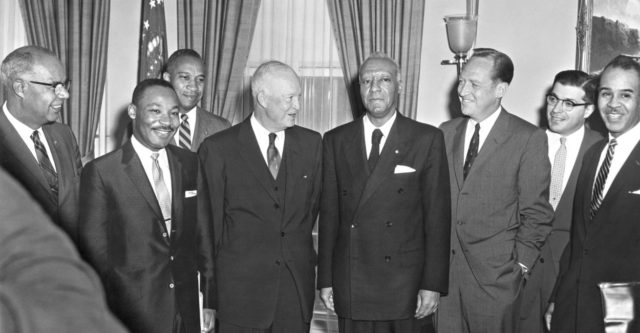
 We can expect the celebration of the 60th anniversary of the May 17, 1954 Brown v. Board of Education Supreme Court decision, to be conducted in the usual reverential manner.
 U.S. Senate Minority Leader Chuck Schumer said in a statement, “The president’s decision to ask Betsy DeVos to run the Department of Education should offend every single American man, woman, and child who has benefitted from the public education system in this country.” Expressing similar sentiments, Congressional Black Caucus Chairman Cedric Richmond said, “I expect that Mrs. DeVos will have an incredibly harmful impact on public education and on black communities nationwide.” Those and many other criticisms of Department of Education Secretary Betsy DeVos could be dismissed as simply political posturing if we did not have an educational system that is mostly mediocre and is in advanced decay for most black students.

 For a number of years, it was assumed that public education was swimming along, efficiently educating children of all ages. More recently, the products coming out of public schools have caused a troubling concern to leap into the minds of adults: are schools dumbing down the content they teach to students?
 Recently I stood in front of my class, observing an all-too-familiar scene. Most of my students were covertly—or so they thought—pecking away at their smartphones under their desks, checking their Facebook feeds and texts.
 Whenever a college student asks me, a veteran high-school English educator, about the prospects of becoming a public-school teacher, I never think it’s enough to say that the role is shifting from “content expert” to “curriculum facilitator.” Instead, I describe what I think the public-school classroom will look like in 20 years, with a large, fantastic computer screen at the front, streaming one of the nation’s most engaging, informative lessons available on a particular topic. The “virtual class” will be introduced, guided, and curated by one of the country’s best teachers (a.k.a. a “super-teacher”), and it will include professionally produced footage of current events, relevant excerpts from powerful TedTalks, interactive games students can play against other students nationwide, and a formal assessment that the computer will immediately score and record.
 The presentation of H.R. 610 by Steve King (R-IA) and co-sponsor Trent Franks (R-AZ) and Pete Olson (R – TX) is a perfect example as to why all these legislators and people like Betsy DeVos who have no experience when it comes to the education of our children other than spending money and writing bills, need to stay as far away from education as possible.
 Why do we have millions of children who never become fluent readers? Easy. Our Education Establishment prefers methods that don’t work.
 Leaving my school building the other day, I had an unexpected realization: Perhaps a computer was a more effective teacher than I currently was. The thought unnerved me, and still does as I’m writing this. I’m a nearly 13-year veteran educator dedicated to reflecting upon and refining my teaching craft. But I’m now considering the real possibility that, for at least part of a class period or school day, a computer could—and maybe should—replace me.
 The percentage of students at Washington, D.C., public schools who graduate from high school in four years is at an all-time high. But at 69 percent, the district’s graduation rate is well below the national average, which is north of 80 percent.