
The constitutional struggle that produced the Bill of Rights and secured enduring protections for individual liberty.
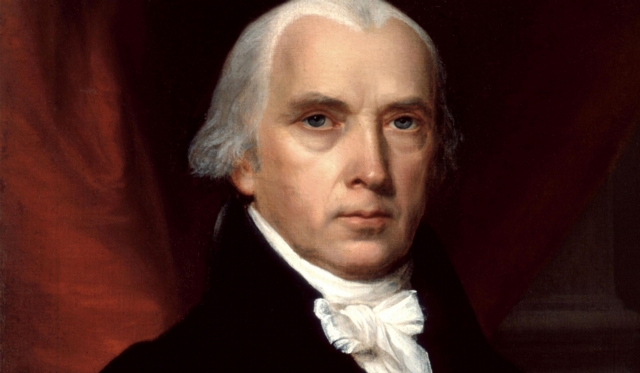
Portrait of James Madison, circa 1805–1807, by Gilbert Stuart. James Madison, originally a Federalist, worked hard to ensure that Antifederalists’ complaints about the Constitution would be addressed.
Less than three years after the Treaty of Paris ended America’s War for Independence in 1783, the infant nation still struggled to find its footing. Great Britain’s overreach of power – its writs of assistance, quartering of troops, and lack of jury trials – was still fresh in Americans’ memories, making many wary of concentrating too much authority in a centralized government. Yet it had become clear that the new nation’s Articles of Confederation were too weak to command order among the 13 states. Something had to be done.
In May 1787, delegates convened in Philadelphia to discuss a solution. For the next four grueling months, they debated, dissembled, and ultimately discarded the Articles of Confederation, drafting in its place the framework for the United States Constitution. Many issues were on the table – most heatedly, federal and executive power, representation in Congress, and commerce across state borders. Of the 55 delegates in attendance, only 39 signed the final document.
Three men – George Mason, Elbridge Gerry, and Edmund Randolph – refused to sign for a particular matter of conscience: The document didn’t include a Bill of Rights.
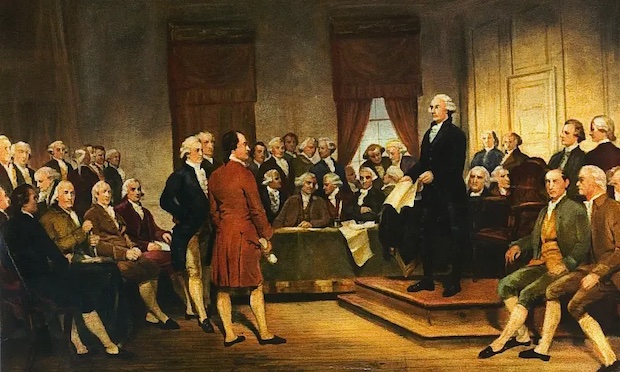
“Washington at Constitutional Convention of 1787, signing of U.S. Constitution,” 1856, by Junius Brutus Stearns
The Stakes
Politically, the Constitutional Convention delegates fell into two major camps: Federalists and Antifederalists.
Antifederalists were in the political minority, but they argued strongly for a bill of rights that explicitly stated the fundamental rights of the people so that the limits of government were clearly defined. This was not a new idea – seven of the 13 states had already attached prefatory declarations of rights to their state constitutions. But because the U.S. Constitution would give the federal government more power than the states, Mason argued, “the Declaration of Rights in the separate States are no security.”
The Federalists disagreed, believing a bill of rights to be unnecessary. In No. 84 of “The Federalist Papers,” Alexander Hamilton went even further, writing that the “bills of rights, in the sense and to the extent in which they are contended for, are not only unnecessary in the proposed Constitution, but would even be dangerous. They would contain various exceptions to powers not granted; and, on this very account, would afford a colorable pretext to claim more than were granted.” In the Federalist view, any rights or powers not expressly granted to the federal government were reserved for the states. That made omitting a bill of rights from the U.S. Constitution a safer course, they argued, because authority over those rights would then default to the states.
The bill of rights debate was deadlocked.
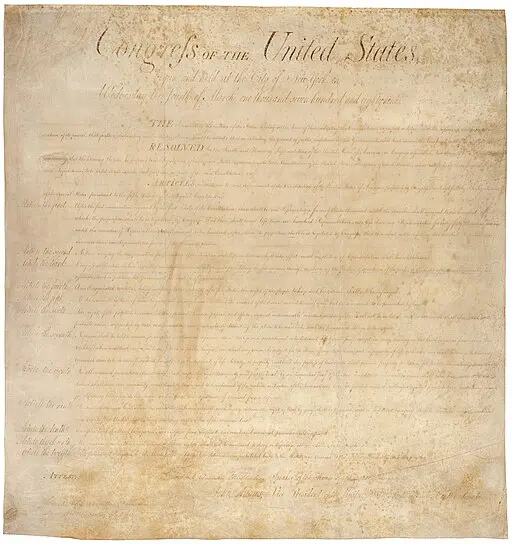
The original Bill of Rights, ratified in 1791, consists of the first 10 amendments to the U.S. Constitution, defining fundamental liberties and limits on federal power.
Compromise
Disagreement was par for the course at the Constitutional Convention, and no one approved the Constitution in its entirety. As James Wilson, a lawyer and delegate from Pennsylvania, said, “I am not a blind admirer of this plan of government, and that there are some parts of it, which, if my wish had prevailed, would certainly have been altered.” With this in mind, the delegates added Article V to the Constitution, allowing it to be amended with an overwhelming majority in Congress and state legislatures.
However, the entire endeavor threatened to unravel at the Massachusetts ratifying convention, where Antifederalists had enough support to vote against the Constitution. Fearing that a rejection in Massachusetts would encourage other states to follow suit, the Federalists proposed a compromise: ratify now, but recommend amendments later. Massachusetts agreed, as did six of the remaining seven states.
The Constitution was saved, but only with the understanding that amendments would soon follow.
The Champion Who Didn’t Care for It
Initially, James Madison thought the bill of rights unnecessary. But when he was elected as Virginia’s senator in the winter of 1788–89 on the promise that he would support amendments, he wrote that he felt bound “as an honest man” to follow through. Moreover, he told Thomas Jefferson, “I have favored it because I supposed it might be of some use, and if properly executed could not be of disservice.”
Despite his lukewarm personal opinion, Madison threw himself into the task. He combed through the states’ recommended amendments, selecting rights-related amendments that would win support in Congress and the states. He also added a few of his own. “It is limited to points which are important in the eyes of many and can be objectionable in the eyes of none,” he wrote to Edmund Randolph in June 1789, enclosing a copy of his proposal. “The structure & stamina of the Govt. are as little touched as possible.”
George Washington received his own copy, to which he replied, “Not foreseeing any evil consequences that can result from their adoption, they have my wishes for a favourable reception in both houses.”
But while Madison’s dedication to the Bill of Rights grew, his colleagues’ waned. The same congressional elections that had put Madison in the Senate had voted many Federalists into office, and few of them wanted to make constitutional amendments a priority. According to historian Gordon S. Wood, when Madison introduced his list of 19 amendments to the House of Representatives on June 8, 1789, he “hounded his colleagues relentlessly” to secure its passage.
Partly out of respect for him, the House passed a joint resolution containing 17 of his amendments. From there, the Senate cut it down to 12. In December 1791, Virginia became the 10th state to ratify 10 of the amendments, giving them legal effect as the U.S. Bill of Rights.
President and Founding Father John Adams once said, “Our Constitution was made only for a moral and religious People. It is wholly inadequate to the government of any other.”
Freedom Under Construction
There have been 27 amendments to the Constitution, covering everything from the right to bear arms to the abolition of slavery. One of the amendments rejected by the states in 1791 – limiting congressional pay raises – was ratified 201 years later, in 1992.
The Founding Fathers weren’t naive enough to believe the Constitution was a perfect document. “The problem to be solved,” James Madison wrote, “is, not what form of Govt. is perfect, but which of the forms is least imperfect.”
Americans of his time were painfully aware of the costs of unchecked government power. The U.S. Bill of Rights not only defends the people’s fundamental liberties – it also clarifies the Constitution’s commitment to the people it governs.
Written by Andria Pressel for Epoch Times ~ January 27, 2026