
“Would it be possible for government to have credit, without having the power of raising money?”
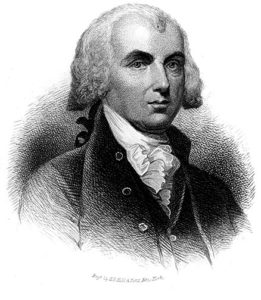
RICHMOND, Va., June 6, 1788 – James Madison, second only to Thomas Jefferson as architect of the new Federal Constitution, today urged ratification of that document in most compelling terms, as he addressed the Convention of Virginia on the need for a responsible, powerful central government but one to be held in check by a care~y contrived diversification of protections for the individual states.
His speech pointed up the vagaries of arguments mustered against the Constitution since its completion by the Philadelphia Convention a year ago. As he spoke here, the principal argument to be overcome was the fear that Virginia, already having assumed responsibility for its debts incurred in the Revolution, would be made the tax dupe of other and less provident states in future tax laws by the Federal Government. This fear was not unlike the arguments advanced in the New York Convention one year ago, when Alexander Hamilton was attempting to allay similar fears on the part of New York’s vested interests.
Mr. Madison, at 33 years of age, has few of the arts of oratory, but he already has shown by his writings his capacity to muster argument with cogent words, as when he stated, “Direct taxes will only be recurred to for great purposes.”
Mr. Jefferson, for reasons of politics, has assumed the role of elder statesman and left the carrying of debate to others. General George Washington, himself the chairman of the Constitutional Convention in Philadelphia, has remained aloof and silent at Mt. Vernon.
Thus the field of political argument on behalf of the great document has been left mainly in the hands of a younger group headed by Mr. Madison and lesser known figures such as John Marshall, who has yet to make his own appeal.
Give me leave to say something of the nature of the government, and to show that it is perfectly safe and just to vest it with the power of taxation. There are a number of opinions; but the principal question is, whether it be a federal or a consolidated government . . . I myself conceive that it is of a mixed nature; it is, in a manner, unprecedented. We cannot find one express prototype in the experience of the world: it stands by itself. In some respects, it is a government of a federal nature; in others, it is of a consolidated nature.
Were it . . . a consolidated government, the assent of a majority of the people would be sufficient for its establishment, and as a majority have adopted it already, the remaining States would be bound by the act of the majority, even if they unanimously reprobated it . . . but, sir, no State is bound by it, as it is, without its own consent. Should all the States adopt it, it will be then a government established by the thirteen States of America, not through the intervention of the Legislature, but by the people at large. In this particular respect, the distinction between the existing and proposed governments is very material
The existing system has been derived from the dependent, derivative authority of the Legislatures of the States; whereas this is derived from the superior power of the people. If we look at the manner in which alterations are to be made in it, the same idea is in some degree attended to. By the new system, a majority of the States cannot introduce amendments; nor are all the States required for that purpose; three-fourths of them must concur in alterations; in this there is a departure from the federal idea. The members to the national House of Representatives are to be chosen by the people at large, in proportion to the numbers in the respective districts. When we come to the Senate, its members are elected by the States in their equal and political capacity; but had the government been completely consolidated) the Senate would have been chosen by the people, in their individual capacity, in the same manner as the members of the other House.
Thus it is of complicated nature) and this complication, I trust, will be found to exclude the evils of absolute consolidation, as well as of a mere confederacy. If Virginia were separated from all the States, her power and authority would extend to all cases; in like manner, were all powers vested in the general government, it would be a consolidated government; but the powers of the Federal government are enumerated; it can only operate in certain cases: it has legislative powers on defined and limited objects, beyond which it cannot extend its jurisdiction
But the honorable member has satirized, with peculiar acrimony, the power given to the general government by this Constitution. I conceive that the first question on this subject is, whether these powers be necessary; if they be, we are reduced to the dilemma of either submitting to the inconvenience, or losing the Union. Let us consider the most important of these reprobated powers; that of direct taxation is most generally objected to. With respect to the exigencies of government, there is no question but the most easy mode of providing for them will be adopted.
When, therefore, direct taxes are not necessary, they will not be recurred to. It can be of little advantage to those in power to raise money in a manner oppressive to the people. To consult the conveniences of the people will cost them nothing, and in many respects will be advantageous to them. Direct taxes will only be recurred to for great purposes.
 What has brought on other nations those immense debts, under the pressure of which many of them labor? Not the expenses of their governments, but war . . . How is it possible a war could be supported without money or credit? And would it be possible for government to have credit, without having the power of raising money? No, it would be impossible for any government, in such a case, to defend itself. Then, I say, sir, that it is necessary to establish funds for extraordinary exigencies, and give this power to the general government; for the utter inutility of previous requisitions on the States is too well known. Would it be possible for those countries, whose finances and revenues are carried to the highest perfection, to carry on the operations of government on great emergencies, such as the maintenance of a war, without an uncontrolled power of raising money? Has it not been necessary for Great Britain, notwithstanding the facility of the collection of her taxes, to have recourse very often to this and other extraordinary methods of procuring money? Would not her public credit have been ruined, if it was known that her power to raise money was limited? Has not France been obliged, on great occasions, to recur to unusual means, in order to raise funds? It has been the case in many countries, and no government can exist unless its powers extend to make provisions for every contingency.
If we were actually attacked by a powerful nation, and our general government had not the power of raising money, but depended solely on requisitions, our condition would be truly deplorable: if the revenues of this commonwealth were to depend on twenty distinct authorities, it would be impossible for it to carry on its operations. This must be obvious to every member here: I think, therefore, that it is necessary for the preservation of the Union that this power should be given to the general government.

Postlogue:
On June 26, the Convention of Virginia ratified the Constitution by a majority vote, but protracted debate, prior to that vote robbed this proud State of the opportunity to become the historic ninth state to ratify, thereby rounding out the necessary two-thirds favorable actions by those States that comprised the original thirteen.
Five days earlier, small New Hampshire had become the ninth state to act favorably. New York followed Virginia by thirty additional days, with its convention bowing to popular will on July 26, 1788.
What a year it had been – this year of searching debate, argument and counter-argument that went so far to elucidate the climate of political opinion in which the future Federal status of the United States was germinating!
Out of that debate, Madison would go forward, in the order of seniority, to occupy the White House as President, third in line after Washington, and preceded by John Adams and Thomas Jefferson. Another Virginian, John Marshall, who delivered his own impassioned plea for ratification by Virginia four days after Madison spoke, would live to become Chief Justice of the Supreme Court and there spend 35 years writing and guiding the decisions that would arm with irrevocable legal force even today the points of law imbedded in the Constitution now under such debate.
Within a year, in the meantime, the Constitution would be translated into political form as Government and law, weak at first in structure but lusty in growth under the benevolent despotism of its first President, George Washington.