
‘The economic transformation Washington put in place was neither preordained nor inevitable.’ ~ Historian Charles Ansary
 Americans today have reached unprecedented heights of prosperity, but our economic system rests on a foundation that was built centuries ago under the direction of the nation’s first president, George Washington.
“Not unlike our political form of government, the economic transformation Washington put in place was neither preordained nor inevitable,” historian Charles Ansary writes in his biography, “George Washington: Dealmaker in Chief.”
The prosperity that Americans enjoy today is rather the product of the decisions, protocols, and precedents established during Washington’s presidency, which set a path for future administrations to follow.
Unique among America’s founders, most of whom studied law, Washington’s life was that of a hands-on businessman, entrepreneur, and soldier. This not only molded his actions as president but also played an essential role in setting the course for America’s economic future.
“Washington’s legacy clearly reflects a man whose early years were shaped by the practical demands of running businesses and managing land,” Allen Mendenhall, an economics research fellow at the Heritage Foundation, told The Epoch Times. “Unlike many of his peers trained in law, Washington’s education came through experience with markets, finances, and agricultural innovation.”
Living Under British Rule
Washington’s father died when he was 11, and rather than getting a formal education like many of his peers, young George went to work. He began as a surveyor, and over time through personal investment, inheritance, and marriage, he eventually accumulated an 8,000-acre estate.
In managing his properties, he built a reputation for innovation, hard work, and attention to detail. However, along the way he also had to navigate the tribulations of British rule.
The experiences of American colonists leading up to the revolution are often unappreciated today. A history book titled, “George vs. George,” which is used to teach elementary school students, portrays Britain’s rule over the American colonies as relatively gracious. In the years leading up to the revolution, author Rosalyn Schanzer writes, King George “got rid of all import taxes except for one tiny tax on British tea,” but colonists “resented paying any British taxes, no matter how tiny.”
However, the causes that ultimately led to revolution went far beyond taxes.
The British saw the American colonies primarily as a source of raw materials. Americans, typically farmers, were forbidden by law from engaging in manufacturing, and by law they could only buy the manufactured products they needed from British firms, Ansary writes.
Selling their produce abroad could only go through British traders, and the traders set the prices. Commerce among the colonies was also banned.
Credit, essential to finance the time between planting and payment, could only be had through British financiers. Americans ran chronic trade deficits with their British overlords, and pounds sterling—the only currency bankers would accept—was in short supply.
“The British mercantilist system … forced American planters to grow tobacco and sell it through British agents on British ships, who shipped it overseas and sold it on behalf of the planters,” historian and University of Virginia professor Edward Lengel stated in a Wharton Business School interview.
In return, Americans received not cash but credit that they could use to buy British manufactured goods, at whatever prices the British charged for them, Lengel stated. During bad harvests, or times of surplus when traders cut prices, many farms failed and colonists lost their land to British bankers.
Colonists could appeal to local governors and judges, but these positions were appointed by the king and habitually sided with the home country. And as detailed in the Declaration of Independence, numerous appeals to the king on these issues and others fell on deaf ears.
Washington coped with these conditions by fighting to keep his farm out of debt and diversifying the income sources from tobacco, where he could not make a profit, to wheat, corn, hemp, flax, fruits, and vegetables, which he could sell locally and avoid British traders. He established a mill to grind wheat into flour, stills to produce alcohol, and looms and spinning wheels to make wool and cotton, selling these products for higher margins.
Seeking a Better Way to Govern
All of these experiences informed Washington’s beliefs and values when, in April 1789, he became America’s first president.
“Examining his presidency without considering his decades as an entrepreneur leaves the picture incomplete,” Mendenhall said. “His emphasis on institutional restraint, financial soundness, and commercial stability reflected the perspective of someone who had built and managed complex enterprises over many years.”
Washington was driven to find a better way for government to operate.
He “was keenly aware of the unfairness of the previous system, characterized as it was by graft, inequality and central control of the colonial economies,” Ansary writes. “He knew how and why it had to be changed.”
Having endured the oppression of British rule, Washington in his inaugural address joined with those who demanded that essential civil liberties to be protected by law. These protections were made manifest in the Bill of Rights, ratified as constitutional amendments in 1791.
Having endured a system of patronage and corruption, Washington worked to establish the credibility of public officials.
“In all our appointments of persons to fill domestic and foreign offices, let us be careful to select only such as are distinguished for morals and abilities,” Washington stated.
Stability, Peace, and Prosperity
He set four essential goals for his administration: restoring the nation’s credit, establishing a stable currency, building America’s infrastructure, and keeping the peace, Lengel stated.
“Washington believed prosperity grew from the work of citizens within stable institutions,” Mendenhall said.
“He understood the importance of credit, trade, and property rights because he had relied on them personally,” he said. “His business experience made him skeptical of the idea that government alone could create prosperity through legislation.”
The United States could have chosen at its outset to follow the mercantilist model that dominated Europe at the time, in which the state controlled markets with the goal of accumulating as much wealth as possible for rulers and elites. But Washington believed that personal liberty, individual property rights, a fair judicial system, free markets, and economic stability would generate prosperity for more people.
There was little stability in the United States in its early years, however. The country faced massive unpaid debts, a lack of a reliable currency, a struggling economy, and political fragmentation among the U.S. states.
“The country could have staggered into ruin or stagnation, or it could have broken apart, both politically and physically,” Lengel stated. “It was an important part of Washington’s national policy, tied with his economic policy, to bind the different parts of the nation together through commerce.”
Washington’s administration focused on establishing an open, rules-based economy, with sharp divisions between the state and the private sector. It also endeavored to foster a system in which citizens could access private markets for credit and capital.
Building Credit Markets
“He recognized that credit was essential for expansion and investment,” Mendenhall said.
“His own efforts to diversify Mount Vernon required capital,” he continued. “The issue was not whether credit was needed, but whether it would rest on stable institutions.”
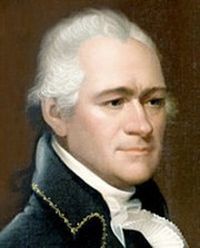
Alexander Hamilton
Together with his Treasury secretary, Alexander Hamilton, Washington worked to establish a stable currency and consolidate the country’s finances to rebuild the nation’s credibility in financial markets.
“When Washington took office, the federal government was essentially bankrupt, and its bonds nearly worthless,” according to the Museum of American Finance. “At Hamilton’s urging, the many federal and state bonds issued during the [Revolutionary] war were replaced with three types of federal bonds that soon traded at yields around 6 percent, down from the high double-digit yields prevalent just a few years before.”
The administration established a system of tariffs to give the federal government the means to service the public debt, although Ansary reports that the tax burden on Americans under Washington still remained lower than that of most other nations. Some of the proceeds, together with private investment, went to investments in public infrastructure, such as roads, communication, and canals to facilitate trade among the states.
A Credible Judicial System
At the same time, Washington recognized the vital importance of America’s newly created judicial system.
“Washington’s business career had shown him that commerce depends on legal stability and fairness,” Mendenhall said.
“He supported the development of an independent judiciary, understanding that courts provided the foundation for enforcing contracts and resolving disputes,” he said. “Property rights, contract enforcement, and equal treatment under the law were not abstract principles to him but necessary conditions for economic activity.”
In September 1789, Washington signed the Judiciary Act, passed by Congress, which established the basis of America’s legal system today.
“The due administration of justice is the strongest cement of good government,” Washington wrote. “The first organization of the judicial department is essential to the happiness of our country.”
He appointed judges, including John Jay as chief justice, based on their reputations for competence and fairness.
“As president, he carefully respected constitutional limits, establishing the precedent that even the chief executive was subject to the law,” Mendenhall said. “This principle was essential not only for political liberty but also for economic confidence.”
Washington also endeavored to maximize the opportunities for Americans to sell and trade what they produced. He not only worked to facilitate trade among the states, but negotiated trade deals abroad.
When the French went to war with England in 1793, France requested that America join the fight against the British in gratitude for France’s help during the American Revolution.
In order to keep the new nation at peace and to maintain access to British markets, Washington declined. According to Lengel, also Washington believed that Americans needed to keep abreast of British manufacturing techniques, which led the world at the time in technological development.
“He studied the French and the British economies and saw that the French were very backwards, whereas the British were the most advanced economic nation in the world, both in terms of their agricultural revolution and their industrial revolution,” Lengel stated.
Faith and Optimism

An engraving of George Washington from 1859.
Above all, Washington brought to the first presidency a sense of faith and optimism in the American people and the nation they were building under the then-radical notion that people can and should govern themselves.
In 1796, after two terms in office, Washington happily returned to private life at his Virginia estate, Mount Vernon.
In his farewell speech, he urged Americans to hold on to the liberty and prosperity they had gained and wished for his compatriots “that Heaven may continue to you the choicest tokens of its beneficence; that your Union and brotherly affection may be perpetual; that the free Constitution, which is the work of your hands, may be sacredly maintained; that its administration in every department may be stamped with wisdom and virtue; that the happiness of the people of these States, under the auspices of liberty, may be made complete.”
Written by Kevin Stocklin for The Epoch Times – February 16, 2026